
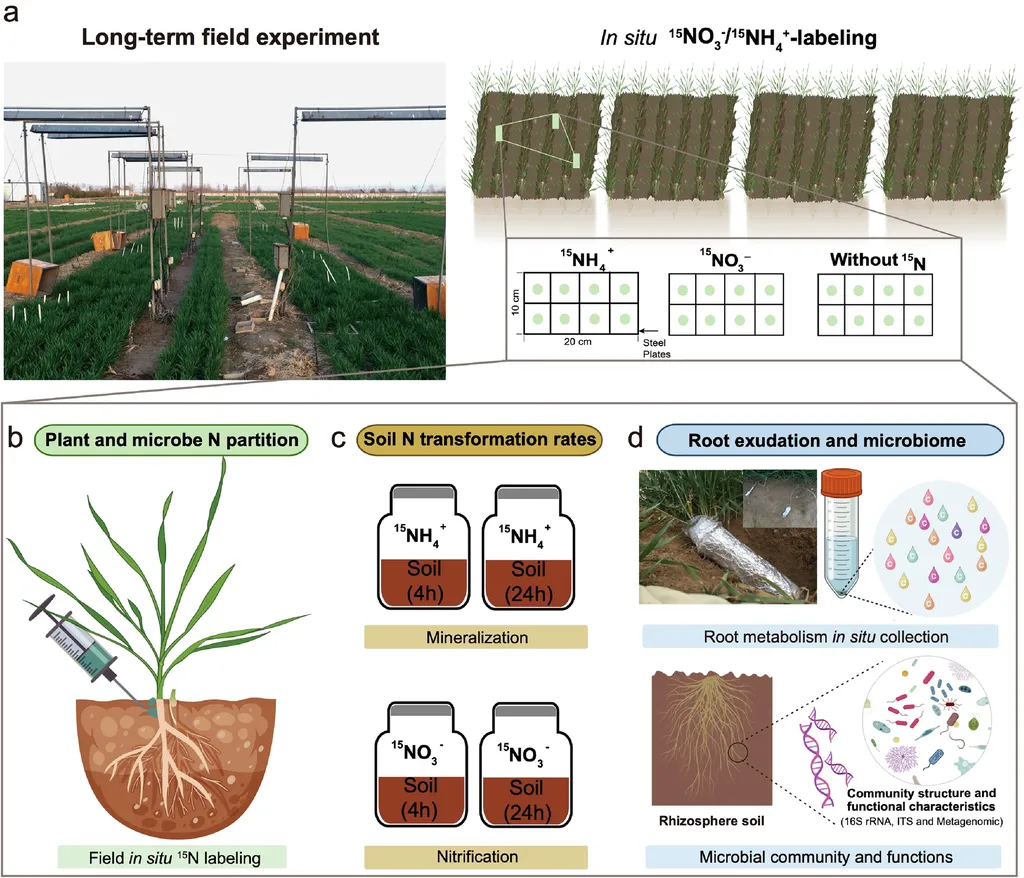
In the face of a warming climate, farmers are grappling with the challenge of maintaining sustainable crop production. A recent study published in *Nature Communications* offers a promising strategy: conservation agriculture. The research, led by Cunkang Hao from the State Key Laboratory of Nutrient Use and Management at China Agricultural University, reveals that conservation agriculture can significantly enhance wheat’s ability to acquire nitrogen, a critical nutrient for plant growth, by fostering beneficial plant-soil-microbe interactions.
The study, which involved a decade-long experiment, compared the effects of conservation agriculture—characterized by minimal soil disturbance, permanent organic soil cover, and crop rotation—with conventional agriculture. The findings are striking. Under warming conditions, conservation agriculture amplified wheat’s nitrate uptake by 25% compared to conventional methods. This boost in nitrogen acquisition is attributed to a complex interplay of factors.
“Warming increases soil gross nitrogen mineralization and nitrification rates by 191% and 159%, respectively, but decreases microbial immobilization by 24% in conservation agriculture,” explains Hao. This shift in nitrogen dynamics is driven by changes in root metabolites, which in turn reshape the functional niches of nitrogen-cycling microbes. Essentially, conservation agriculture creates an environment where wheat plants can outcompete soil microorganisms for nitrogen, leading to more efficient carbon-nitrogen exchange.
The commercial implications for the agriculture sector are substantial. As climate change continues to impact global food security, farmers are in urgent need of sustainable strategies to maintain crop yields. Conservation agriculture, with its potential to enhance nitrogen use efficiency, offers a viable solution. By reducing the need for synthetic fertilizers, farmers can lower input costs and minimize environmental impacts, such as nitrogen runoff and greenhouse gas emissions.
Moreover, the study’s findings suggest that conservation agriculture can help mitigate the negative effects of climate change on crop production. By fostering beneficial plant-soil-microbe interactions, this land management strategy can enhance crop resilience to warming temperatures, ensuring food security in an uncertain climate future.
Looking ahead, this research could pave the way for further developments in agritech. For instance, scientists could explore the potential of targeted microbial inoculants to further enhance nitrogen acquisition in crops. Additionally, precision agriculture technologies could be leveraged to optimize conservation agriculture practices, tailoring them to specific crop types and environmental conditions.
In conclusion, this study highlights the potential of conservation agriculture to enhance crop nitrogen acquisition and mitigate the impacts of climate change. As the agriculture sector grapples with the challenges of a warming world, this research offers a promising strategy for sustainable crop production. By fostering beneficial plant-soil-microbe interactions, conservation agriculture can enhance crop resilience and ensure food security in the face of climate change.