
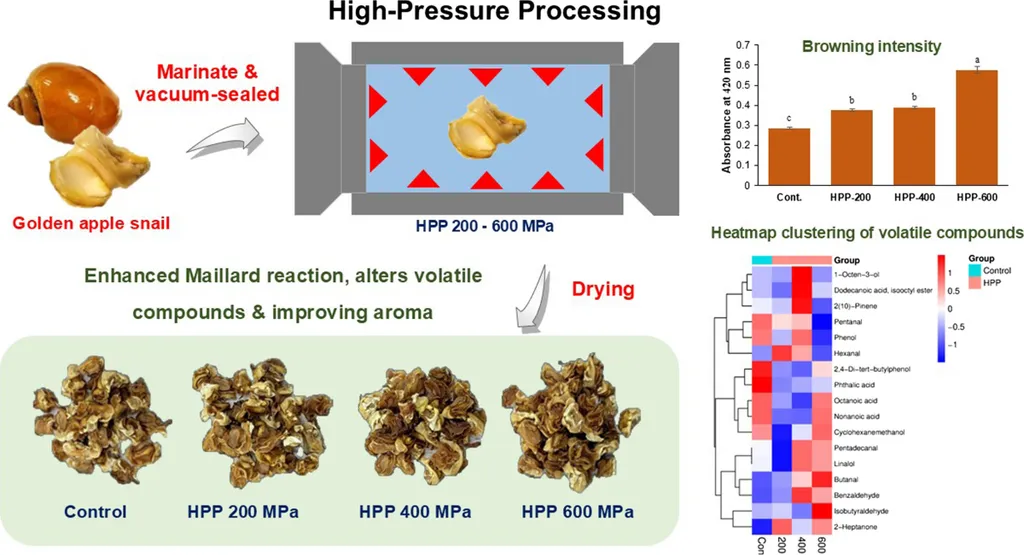
In the quest to enhance the sensory quality of processed foods, researchers have turned to high-pressure processing (HPP) as a promising pretreatment method. A recent study published in *Food Production, Processing and Nutrition* sheds light on how HPP can significantly boost the Maillard reaction and flavor development in dried golden apple snail (Pomacea canaliculata) meat, offering intriguing possibilities for the agrifood sector.
The study, led by Samart Sai-Ut from the Department of Food Science at Burapha University, explored the effects of different HPP pressure levels—200, 400, and 600 MPa—on the Maillard reaction and volatile compound formation in dried golden apple snails. The Maillard reaction, a chemical process between amino acids and reducing sugars, is crucial for developing the desirable flavors, aromas, and colors in food products.
The researchers found that higher HPP levels accelerated the Maillard reaction while preserving a golden-yellow hue, which is aesthetically appealing to consumers. “HPP at 400 MPa was particularly effective in enhancing the release of key free amino acids that contribute to umami and sweetness,” said Sai-Ut. However, pressures exceeding 600 MPa might degrade amino acids, limiting their release and potentially affecting flavor profiles.
Volatile compound analysis revealed that increased pressure significantly enhanced the formation of aldehydes, ketones, and alcohols, which are essential for flavor development. Fourier transform infrared (FTIR) spectroscopy further showed that HPP induced significant modifications in hydroxyl, carbonyl, and amide functional groups, thereby promoting Maillard reactions and aroma development.
The study also highlighted that drying yield negatively correlated with biochemical parameters, while sensory attributes remained relatively unaffected. This suggests that HPP could be a valuable tool for improving the sensory quality of processed snail products without compromising their overall appeal.
The implications for the agrifood sector are substantial. As consumer demand for high-quality, flavorful, and visually appealing food products continues to grow, HPP pretreatment offers a promising strategy for enhancing the sensory attributes of dried meats and other processed foods. This could open new avenues for farmers and food processors to add value to their products, potentially increasing market competitiveness and profitability.
Moreover, the study’s findings could inspire further research into the application of HPP in other food products, paving the way for innovative processing techniques that enhance flavor, aroma, and overall quality. As the agrifood industry continues to evolve, such advancements could play a pivotal role in meeting the demands of discerning consumers and driving sustainable growth in the sector.
In summary, this research underscores the potential of HPP as a powerful pretreatment method for enhancing the Maillard reaction and flavor development in dried golden apple snails. By leveraging these findings, the agrifood industry can explore new opportunities to improve product quality and meet the evolving preferences of consumers.