
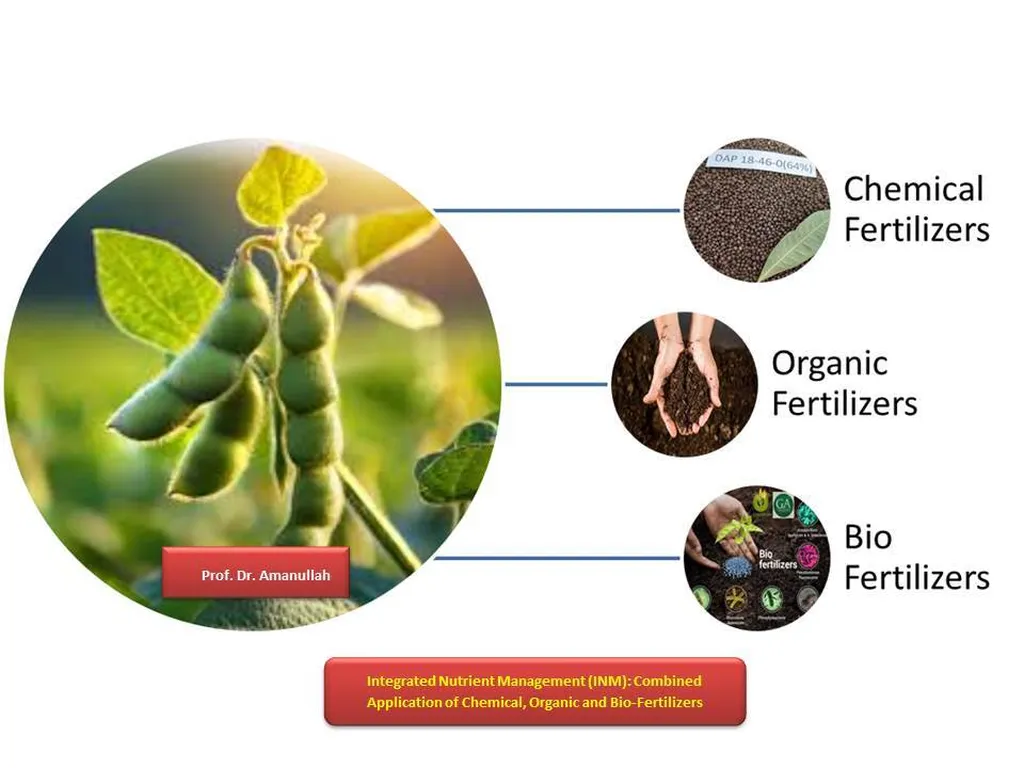
In the face of climate change and degrading soil conditions, soybean farmers are grappling with significant yield challenges. A recent study published in *Scientific Reports* offers a promising solution, combining molecular characterization and fertilizer optimization to boost soybean productivity while minimizing environmental impact. The research, led by Kamran Shehzad Bajwa from the Gene Transformation Lab at the National Institute for Genomics and Advanced Biotechnology (NIGAB), provides a roadmap for sustainable soybean cultivation.
The study begins by addressing the genetic potential of soybean germplasm through molecular characterization. Using SSR markers, the researchers assessed genetic diversity, with principal component analysis accounting for up to 73.8% of the variation. This genetic insight is crucial for understanding how different soybean varieties respond to environmental stresses and nutrient availability.
The research then turns to the critical issue of fertilizer use. Indiscriminate application of nitrogen, phosphorus, and potassium (NPK) fertilizers has long been a concern, as excessive use can compromise soil health and accelerate environmental damage. Bajwa and his team employed a response surface statistical model to predict optimal fertilizer application rates. The model suggests applying nitrogen, phosphorus, and potassium at rates of 65, 40, and 20 kg/ha, respectively, while maintaining soil moisture levels between 100 and 150 mm.
“Our findings demonstrate that integrating molecular characterization with fertilizer optimization can significantly enhance nutrient-use efficiency,” Bajwa explains. “This approach not only boosts soybean productivity but also reduces fertilizer losses and minimizes environmental impact.”
The study’s validation experiment yielded promising results. Out of forty-eight soybean accessions, eleven showed productivity improvements compared to control plants. Notably, accessions such as SPS45, PGRB58, GP40032, GP40067, and GP40136 exhibited enhanced performance under optimized conditions.
The implications for the agriculture sector are substantial. By adopting these findings, farmers can achieve higher yields while reducing their environmental footprint. This is particularly relevant in the context of climate change, where water resource challenges and soil degradation are exacerbating yield limitations.
Looking ahead, this research could shape future developments in precision agriculture. The integration of molecular characterization and fertilizer optimization offers a blueprint for sustainable crop management. As Bajwa notes, “This study paves the way for more targeted and efficient agricultural practices, ensuring food security while preserving our natural resources.”
In an era where sustainability and productivity are paramount, this research provides a valuable tool for soybean farmers and agronomists alike. By leveraging genetic insights and optimizing fertilizer use, the agriculture sector can move towards a more sustainable and productive future.