
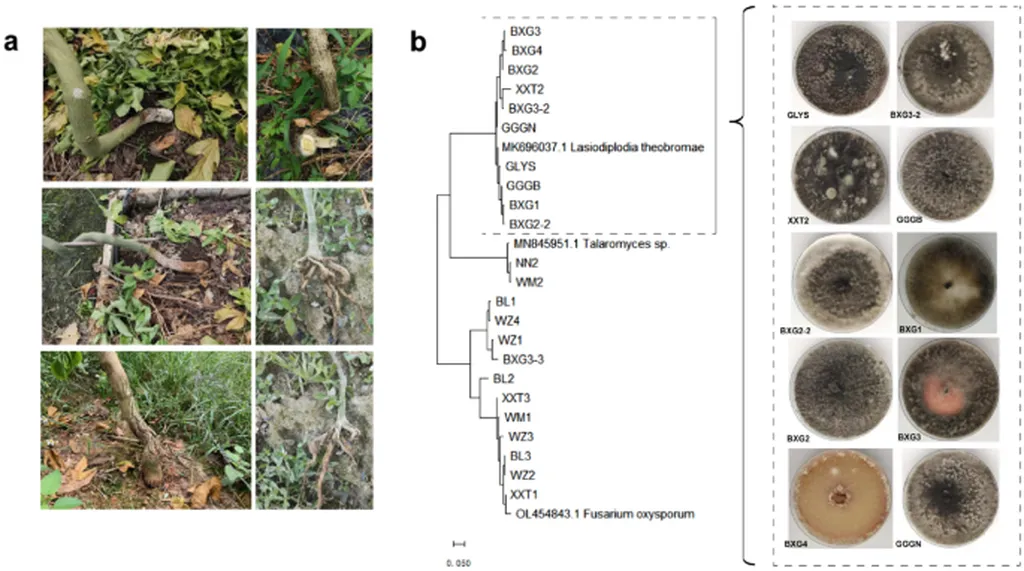
In the heart of China’s Guangxi region, a team of researchers has made a significant stride in the battle against stem rot disease, a persistent threat to passion fruit production. Their findings, published in the journal *Horticultural Science*, offer a beacon of hope for farmers and breeders alike, promising to reshape the future of passion fruit cultivation.
Stem rot, caused by the fungus *Fusarium solani*, has long been a scourge in passion fruit orchards, leading to substantial yield losses and economic hardship for growers. The research, led by Yanyan Wu from the Biotechnology Research Institute at the Guangxi Academy of Agricultural Sciences, aims to identify and validate genes responsible for resistance to this devastating disease.
The team conducted artificial inoculation of *Fusarium solani* on leaves of two passion fruit varieties, ‘Huangjinguo’ and ‘Ziguo 7’. By collecting leaf samples at 0 h, 24 h, and 48 h post-inoculation for RNA-sequencing (RNA-seq) analysis, they identified a trove of differentially expressed genes (DEGs) at each stage. “This comprehensive analysis allowed us to pinpoint genes that are crucial in the plant’s defense mechanism against stem rot,” Wu explained.
Gene Ontology (GO) analysis revealed that these DEGs are associated with vital functions such as response to reactive oxygen species (ROS), response to hydrogen peroxide, and protein complex oligomerisation. Kyoto Encyclopedia of Genes and Genomes (KEGG) analysis further highlighted the enrichment of DEGs in the phenylpropanoid biosynthesis pathway, which includes genes implicated in lignin biosynthesis. Lignin, a key component of plant cell walls, plays a pivotal role in plant defense mechanisms.
One of the most intriguing findings came from the Weighted Gene Co-expression Network Analysis (WGCNA), which identified three modules significantly associated with passion fruit stem rot resistance. Network analysis highlighted ZX.08G0013660 as the gene with the highest connectivity in these modules, featuring a leucine-rich repeat domain. “This gene stands out as a potential candidate for conferring resistance to stem rot disease,” Wu noted.
Reverse transcription quantitative real-time polymerase chain reaction (RT-qPCR) analysis validated ZX.08G0013660 and other genes as potential candidates for passion fruit stem rot resistance. The study suggests that genes related to ROS, phenylpropanoid biosynthesis, and leucine-rich repeat domain protein likely play critical roles in passion fruit stem rot resistance.
The implications of this research are profound for the agriculture sector. By identifying these resistance genes, breeders can develop passion fruit varieties that are more resilient to stem rot disease, thereby increasing yields and reducing economic losses for farmers. “This research provides a foundation for breeding programs aimed at developing stem rot-resistant passion fruit varieties,” Wu said.
The findings also open new avenues for understanding the molecular mechanisms underlying disease resistance in passion fruit and other crops. Future research could explore the functional characterization of these genes and their potential applications in genetic engineering and crop improvement.
As the global demand for passion fruit continues to rise, driven by its nutritional benefits and versatility in food products, the need for disease-resistant varieties becomes ever more pressing. This study, published in *Horticultural Science* and led by Yanyan Wu from the Biotechnology Research Institute at the Guangxi Academy of Agricultural Sciences, offers a promising path forward, empowering the agriculture sector to meet these challenges head-on.