
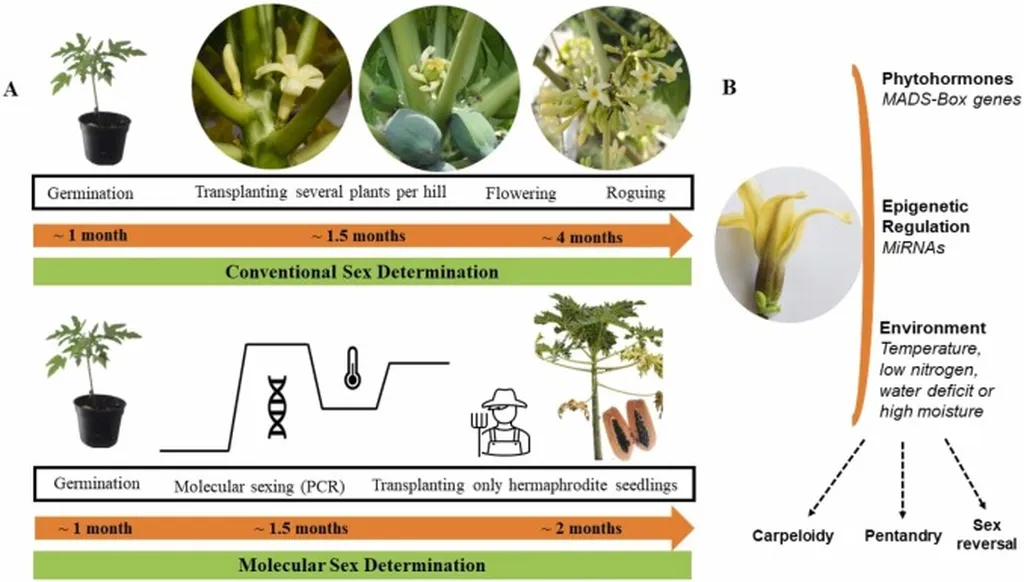
In the world of papaya cultivation, determining the sex of plants early in their growth cycle has long been a challenge. Traditional methods are time-consuming and often unreliable, leading to inefficiencies in the field. However, a recent study published in *Horticultural Science* offers a promising solution that could revolutionize papaya farming. The research, led by K Soumiya from the Department of Fruit Science at Tamil Nadu Agricultural University, introduces a robust molecular marker technique that accurately identifies the sex of papaya plants at an early stage.
The study focused on two popular papaya cultivars, CO 7 and CO 8, which are known for their gynodioecious and dioecious sex expressions, respectively. Using the RAPD-SCAR (randomly amplified polymorphic DNA-sequence characterised amplified region) marker, T12, the researchers were able to distinguish between male, female, and hermaphrodite plants with remarkable accuracy. “The presence of the T12 marker indicated male lines, while its absence indicated female or hermaphrodite lines,” explained Soumiya. This method achieved an impressive 97% accuracy for CO 7 and 98% for CO 8, ensuring that growers can make informed decisions early in the cultivation process.
The implications for the agriculture sector are significant. By employing molecularly certified papaya seedlings with predetermined sex, farmers can save up to 55% on labour costs compared to conventional methods. This is a game-changer for papaya producers, as it eliminates the need to remove male plants later in the growth cycle, a process that is both labour-intensive and costly. “This technique not only saves time and resources but also ensures that more hermaphrodite plants, which produce superior fruits, are cultivated,” noted Soumiya.
The study also confirmed the reliability of the T12 marker by using an oligomer primer called OPA 04 as a control. This step ensured that the absence of the SCAR marker was not due to experimental error but rather the non-existence of the complementary target region. Additionally, a similarity search of the sequences of the polymerase chain reaction (PCR) product amplified by T12 from CO 7 and CO 8 highlighted that they matched with male-specific regions of the papaya Y chromosome, further validating the findings.
The commercial impact of this research is substantial. Papaya growers and breeders can now identify the sex of their plants early, guaranteeing profitable production. This breakthrough could lead to more efficient farming practices, higher yields, and ultimately, better returns for farmers. As the agriculture sector continues to embrace technological advancements, this molecular marker technique stands out as a practical and effective tool for improving papaya cultivation.
The findings of this study not only address current challenges in papaya farming but also pave the way for future developments in the field. As researchers continue to explore the potential of molecular markers, we can expect further innovations that will enhance the efficiency and profitability of agricultural practices. This study, published in *Horticultural Science* and led by K Soumiya from the Department of Fruit Science at Tamil Nadu Agricultural University, is a testament to the power of scientific research in driving agricultural progress.