
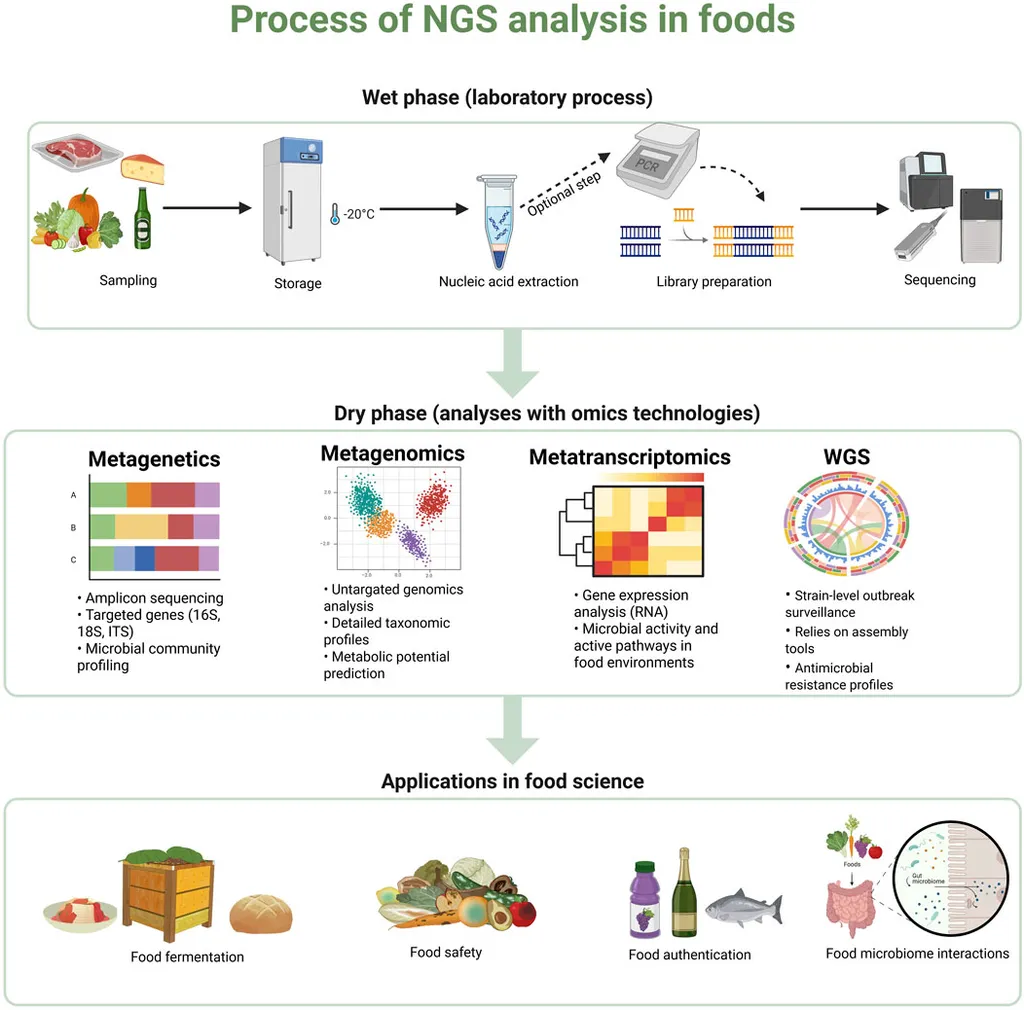
In the ever-evolving landscape of food safety, a groundbreaking study published in the EFSA Journal is set to revolutionize how we assess and manage risks in the dairy industry. The research, titled “Training in metataxonomics‐integrated risk assessment for foodborne pathogens in the Polish and Spanish dairy chain (DAIRYPOL),” delves into the intricate world of metagenomic sequencing, offering insights that could significantly impact commercial dairy production chains.
At the heart of this study is the comparison of two prominent sequencing technologies: Illumina’s short-read sequencing and Oxford Nanopore Technologies’ long-read sequencing. These technologies have been pivotal in detecting pathogens and characterizing microbial communities, but their differences in accuracy, read length, and resolution could profoundly influence risk profiles in quantitative microbiological risk assessment (QMRA).
Joanna Bucka‐Kolendo, the lead author from the Institute of Agricultural and Food Biotechnology – State Research Institute in Warsaw, Poland, explains, “Our research aims to bridge the gap between advanced sequencing technologies and practical food safety management. By comparing these platforms, we hope to provide a more nuanced understanding of microbial populations in dairy chains, ultimately enhancing food safety and quality.”
The study, conducted at the Universidad Politécnica de Cartagena (UPCT) in Spain and the Institute of Food BioResources – National Research Institute (IBPRS-PIB) in Poland, explores how different sequencing strategies affect hazard identification and QMRA outcomes. This comparative analysis is crucial for the dairy industry, as it could lead to more accurate and efficient risk assessments, reducing the likelihood of foodborne illnesses and improving consumer trust.
One of the most exciting aspects of this research is its potential to enhance predictive modeling. By integrating metagenomic data, the study demonstrates how we can better anticipate and mitigate risks in the dairy production chain. “This approach not only supports practical improvements in food safety management but also paves the way for more proactive and data-driven decision-making in the industry,” Bucka‐Kolendo adds.
The commercial implications of this research are vast. For dairy producers, adopting these advanced sequencing technologies could mean more precise monitoring of microbial populations, leading to better control of foodborne pathogens and improved product safety. This, in turn, can enhance market competitiveness and consumer confidence, driving growth and innovation in the sector.
Moreover, the study’s findings could influence future developments in the field, encouraging more widespread adoption of metagenomic sequencing in food safety assessments. As the dairy industry continues to evolve, the integration of these technologies could become a standard practice, ensuring higher levels of safety and quality across the board.
In conclusion, this research represents a significant step forward in the quest for safer and more efficient dairy production. By leveraging the power of metagenomic sequencing, the dairy industry can look forward to a future where food safety is not just a priority but a guaranteed outcome. As the findings from this study continue to be explored and applied, the potential for innovation and improvement in the sector is immense, promising a brighter and safer future for all stakeholders involved.