
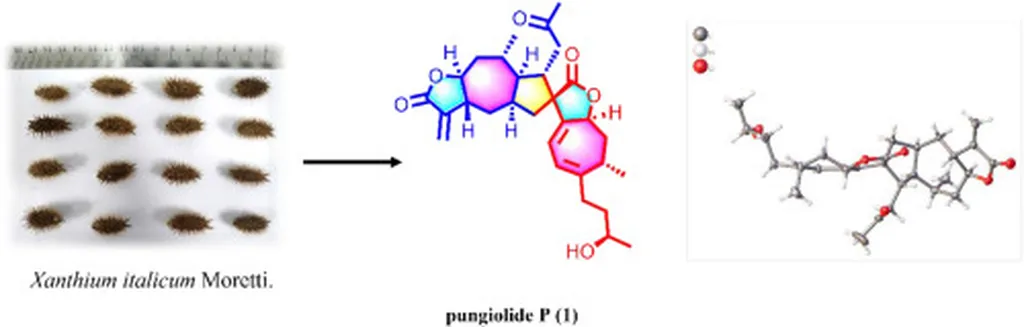
In the ongoing battle against invasive plants that threaten agricultural productivity, researchers have turned to nature itself for solutions. A recent study published in *Industrial Crops and Products* has uncovered promising herbicidal properties in xanthanolide sesquiterpenes derived from *Xanthium sibiricum*, a robust industrial crop. The findings could pave the way for more sustainable and targeted herbicides, potentially reducing reliance on synthetic chemicals.
The research, led by Zhixiang Liu from the College of Bioscience and Biotechnology at Shenyang Agricultural University, isolated and identified eight xanthanolide sesquiterpenes from the stems and leaves of *X. sibiricum*. Among these, compounds 4 through 7 demonstrated significant herbicidal effects against several invasive plant species, including *Ambrosia trifida*, *Solanum rostratum*, and *Xanthium spinosum*. Notably, compound 7 also exhibited potent inhibitory activity against acetolactate synthetase (ALS), an enzyme crucial for the synthesis of branched-chain amino acids in plants.
“These findings are particularly exciting because they suggest that natural compounds from *X. sibiricum* could be developed into effective botanical herbicides,” Liu explained. “This not only provides a more environmentally friendly alternative to synthetic herbicides but also offers a new avenue for utilizing the abundant biomass of *X. sibiricum*.”
The study further investigated the binding mechanisms of these compounds with ALS through docking analyses and dynamic simulations. The results indicated that the xanthanolide sesquiterpenes could effectively inhibit ALS, disrupting the growth of invasive plants. This dual action—herbicidal and ALS inhibitory—makes these compounds particularly promising for agricultural applications.
The potential commercial impact of this research is substantial. Invasive plants cause significant economic losses in agriculture by competing with crops for resources and reducing yield. Current control methods often rely on broad-spectrum synthetic herbicides, which can have detrimental effects on the environment and non-target species. Botanical herbicides derived from *X. sibiricum* could offer a more targeted and sustainable solution, reducing the environmental footprint of weed control.
Moreover, the utilization of *X. sibiricum* stems and leaves, which are often considered agricultural waste, adds economic value to the crop. This could incentivize farmers to cultivate *X. sibiricum* not just for its industrial uses but also for its potential in herbicide production.
As the agricultural sector continues to seek innovative and sustainable solutions to invasive plant management, the findings from this study offer a glimmer of hope. The development of botanical herbicides could revolutionize weed control, providing a more eco-friendly and cost-effective approach. “This research is a stepping stone towards a more sustainable future in agriculture,” Liu added. “It highlights the importance of exploring natural products for practical applications in crop protection.”
With further research and development, the xanthanolide sesquiterpenes from *X. sibiricum* could become a cornerstone in the fight against invasive plants, benefiting farmers and the environment alike. The journey from lab to field is long, but the potential rewards are immense.