
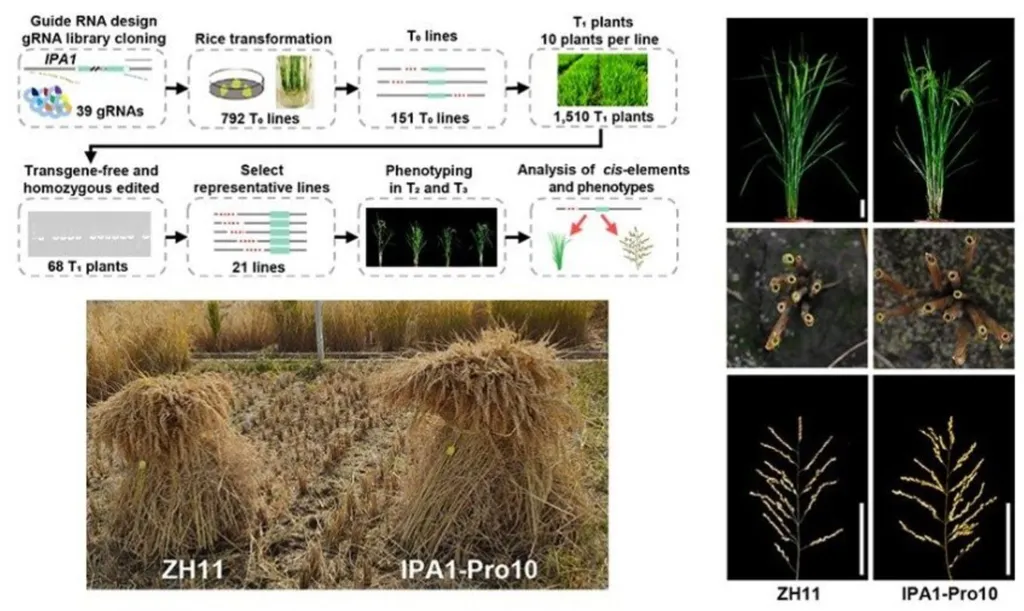
In the quest to bolster rice production, scientists have long grappled with the challenge of lodging—when rice plants bend or fall over, often due to weak stems. This phenomenon can significantly reduce yields, particularly in high-yielding cultivars. A recent study published in *Frontiers in Plant Science* has shed new light on the genetic underpinnings of lodging resistance, offering promising avenues for improving rice varieties.
Researchers led by Qiuyun Lin from the Tropical Crops Genetic Resources Institute, Chinese Academy of Tropical Agricultural Sciences, identified 54 quantitative trait loci (QTLs) associated with internode length and diameter—key traits that influence lodging resistance. Among these, 15 pleiotropic QTLs were found to affect multiple internode-related traits, suggesting a complex genetic interplay.
“Understanding the genetic basis of these traits is crucial for developing rice varieties that can withstand lodging while maintaining high yields,” Lin explained. The study utilized a recombinant inbred line (RIL) population derived from a cross between Zhenshan 97 and C309, two rice varieties with distinct stem architectures. By constructing a high-density genetic linkage map and conducting comprehensive phenotypic analysis, the team was able to pinpoint specific genetic regions associated with lodging resistance.
One of the standout findings was the identification of well-known functional genes such as SCM2 and Gn1a, along with several novel loci. RNA-Seq analysis further revealed 183 differentially expressed genes within the pleiotropic QTL regions, with LOC_Os06g11130 emerging as a key candidate for further investigation. Haplotype analysis confirmed significant variation in this gene, underscoring its potential role in enhancing lodging resistance.
The implications of this research are substantial for the agriculture sector. By identifying major-effect and pleiotropic QTLs, breeders can now leverage marker-assisted selection and genomic breeding to develop rice varieties that balance high yield potential with enhanced lodging resistance. This could lead to more stable and predictable harvests, ultimately benefiting farmers and consumers alike.
“These findings provide valuable genetic resources that can be directly applied in breeding programs,” Lin noted. The study not only advances our understanding of the genetic architecture of internode traits but also paves the way for future developments in rice breeding. As the global demand for food continues to rise, such advancements are crucial for ensuring food security and sustainability in rice production.
With the identification of key genetic markers and candidate genes, the stage is set for the development of rice varieties that are both high-yielding and resilient to lodging. This research, published in *Frontiers in Plant Science* and led by Qiuyun Lin from the Tropical Crops Genetic Resources Institute, Chinese Academy of Tropical Agricultural Sciences, marks a significant step forward in the ongoing effort to improve rice cultivation practices worldwide.