
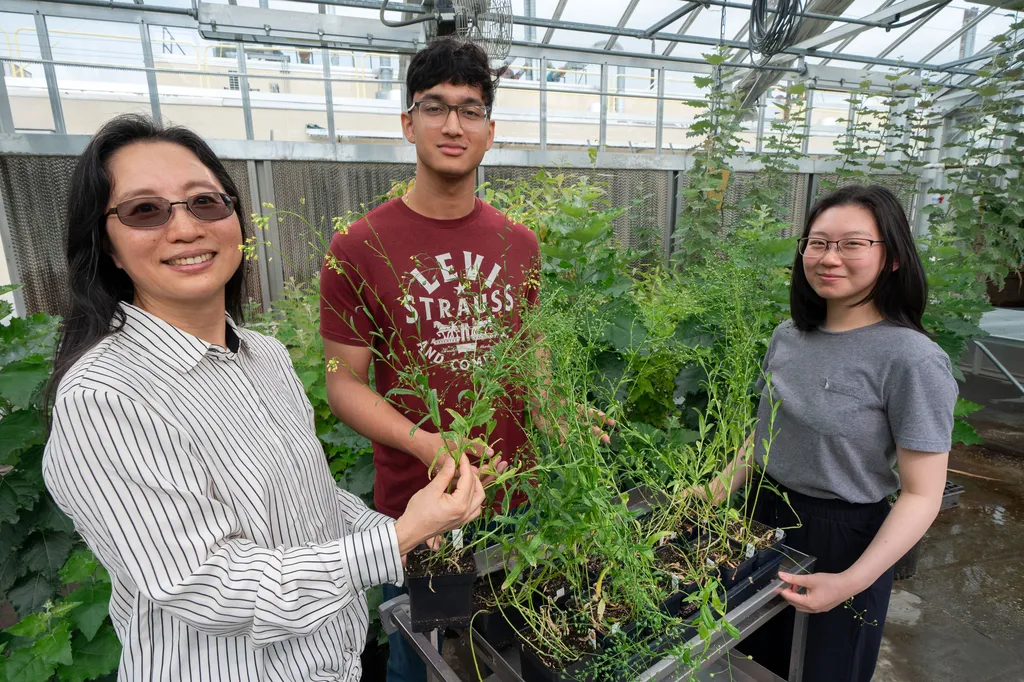
In the quest to boost the yield of yellowhorn, a valuable woody oilseed species, scientists have uncovered a complex network of non-coding RNAs (ncRNAs) that play a pivotal role in the plant’s sex differentiation. This breakthrough, published in *Scientia Horticulturae*, could pave the way for innovative breeding strategies to enhance oil production in this important crop.
Yellowhorn (Xanthoceras sorbifolium Bunge) is prized for its high-quality oil, but its low seed yield has been a persistent challenge for farmers. The key issue lies in the plant’s imbalanced female-to-male flower ratio, which directly impacts seed production. To address this, researchers led by Chu Wang from the Key Laboratory of Biotechnology and Bioresources Utilization at Dalian Minzu University delved into the molecular mechanisms governing flower sex differentiation.
The study identified several key hormones and genes associated with the promotion of female and male flower differentiation. For instance, auxin (IAA) related genes such as SAUR50, ARF4, ARF5, PIN1C, and LAX5, along with strigolactone (SL) related genes like SPL9, D14, and SMXL7, were found to encourage female flower development. On the other hand, abscisic acid (ABA) related genes (PHI-1, NCED1, and CYP707A2) and jasmonic acid (JA) related genes (TIFY10B, TIFY5A, and TIFY9) were implicated in male flower differentiation.
The research team also uncovered 10 miRNA-mRNA regulatory modules and 12 lncRNA-mRNA regulatory modules related to flower sex differentiation. Notably, the SL related miR156-SPLs and IAA related miR167-ARF8 modules were identified as promoters of female flower differentiation, while the ABA related miR159-MYB101 module was associated with male flower differentiation.
One of the most significant findings was the identification of competing endogenous RNA (ceRNA) networks, such as MSTRG.41858.1-miR156-SPL9, which play a crucial role in promoting female flower differentiation. “This ceRNA network provides a direct target for genetic engineering to increase the proportion of female flowers, which could significantly enhance seed yield in yellowhorn,” explained lead author Chu Wang.
The study’s findings were validated through qRT-PCR and dual-luciferase reporter assays, ensuring the reliability of the identified regulatory networks. The interactions within the MSTRG.41858.1-miR156-SPL9 ceRNA network were further confirmed through RNA pulldown experiments.
The implications of this research extend beyond yellowhorn. The hormone-ceRNA crosstalk mechanism revealed in this study offers a new paradigm for sex determination research in other oil-producing plants. This could accelerate the development of sex-controlled breeding systems in perennial crops, ultimately boosting agricultural productivity.
For the agriculture sector, this research opens up new avenues for genetic engineering and breeding programs aimed at optimizing flower sex ratios. By increasing the proportion of female flowers, farmers could achieve higher seed yields, making yellowhorn cultivation more economically viable.
As the global demand for plant-based oils continues to rise, innovations in crop breeding and genetic engineering are crucial. This study not only advances our understanding of sex differentiation in yellowhorn but also sets the stage for similar breakthroughs in other crops, potentially revolutionizing the agriculture industry.