
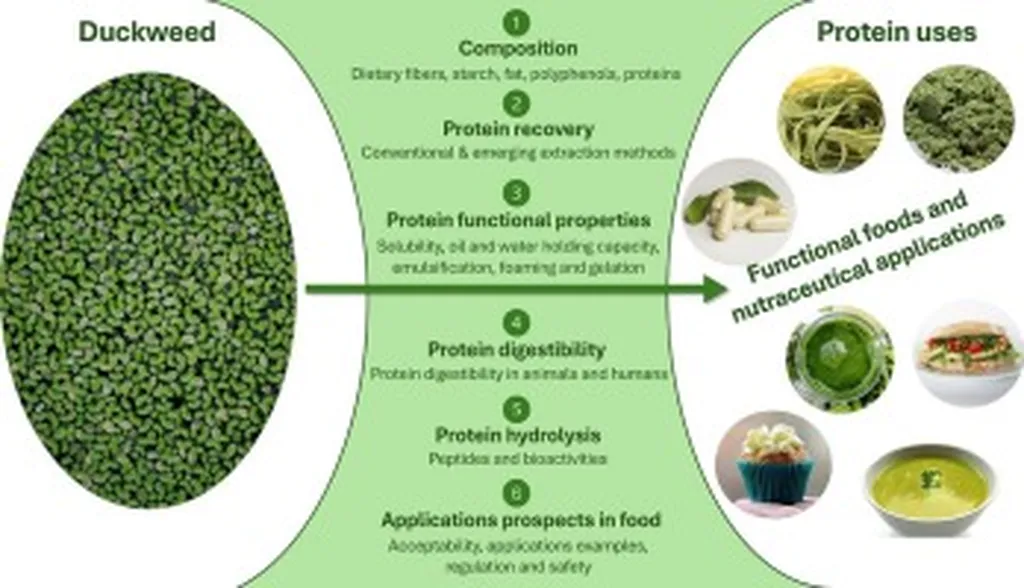
In the quest for sustainable protein sources, duckweed has emerged as a promising candidate, but its dense structure and anti-nutritional factors have posed challenges. A recent study published in the *Journal of Functional Foods* sheds light on how innovative extraction methods can enhance the digestibility and nutritional quality of duckweed protein, potentially unlocking its full potential for the agriculture and food industries.
The research, led by Saowakon Wongsasulak from the Laboratory of Food Technology and Engineering at King Mongkut’s University of Technology Thonburi in Bangkok, Thailand, compared three different extraction methods: alkaline extraction (AE), ultrasound-assisted alkaline extraction (UAAE), and ultrasound-assisted water extraction (UAWE). The goal was to evaluate their impact on protein digestibility, antioxidant capacity, and the release of bioactive peptides during in vitro gastrointestinal digestion.
The findings were striking. Native duckweed powder (DPw) exhibited the lowest digestibility, while the protein extracts obtained through ultrasound-assisted alkaline extraction (DPEUAE) showed the highest. Notably, the ultrasound-assisted water extraction (UAWE) method achieved a Digestible Indispensable Amino Acid Score (DIAAS) of 0.75, meeting the FAO criteria for good protein quality. This is a significant milestone, as it indicates that duckweed protein can be a viable and high-quality protein source when processed correctly.
“Enhanced digestibility strongly correlated with increased bioactive peptide release,” Wongsasulak explained. The DPEUAE method boosted long-chain bioactive peptides by 1.4-fold and short-chain bioactive peptides by 1.8-fold compared to DPw, without altering the distribution of bioactivities. This suggests that the extraction method not only improves digestibility but also enhances the functional properties of duckweed protein.
Moreover, the DPEUAE method demonstrated superior antioxidant capacity, with ACE and DPP-4 inhibitory activities being the top-two predominant bioactivities. This is particularly noteworthy for the food and dietary supplement industries, as antioxidant properties are highly sought after for their health benefits.
The commercial implications of this research are substantial. As the demand for sustainable and plant-based protein sources continues to grow, duckweed could become a key player in the agriculture sector. The study’s findings suggest that with the right processing techniques, duckweed protein can be transformed into a high-quality, functional ingredient suitable for a wide range of applications.
“Ultrasound-assisted extraction effectively produces duckweed protein extracts with enhanced nutritional and functional qualities,” Wongsasulak noted. This could pave the way for the development of new food products and dietary supplements that leverage the unique properties of duckweed protein.
The research not only highlights the potential of duckweed as a sustainable protein source but also underscores the importance of innovative extraction methods in unlocking the full potential of plant-based proteins. As the agriculture sector continues to evolve, such advancements could play a crucial role in meeting the growing demand for sustainable and nutritious food sources.
The study, published in the *Journal of Functional Foods*, was led by Saowakon Wongsasulak from the Laboratory of Food Technology and Engineering at King Mongkut’s University of Technology Thonburi in Bangkok, Thailand. The findings offer a promising glimpse into the future of sustainable protein production and the role that innovative extraction methods can play in enhancing the nutritional quality and functionality of plant-based proteins.