
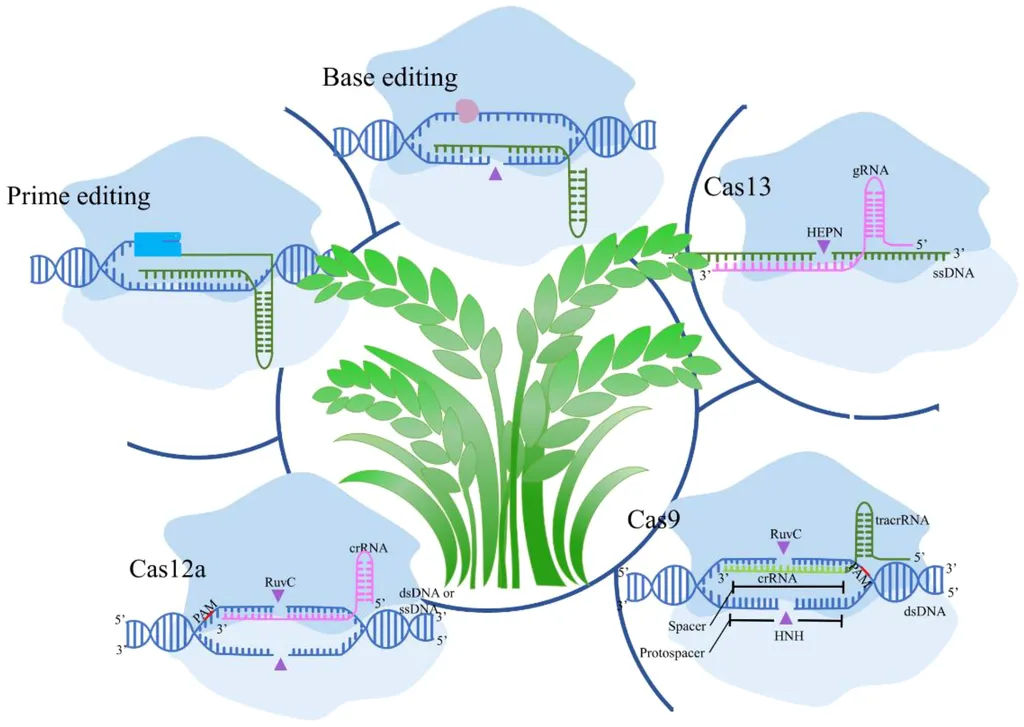
In a significant stride for the field of epigenome editing, researchers have developed a modular and customizable CRISPR/Cas toolkit that promises to revolutionize our understanding and manipulation of gene regulation. This breakthrough, published in *Advanced Science*, opens new avenues for trait design and synthetic biology, with profound implications for the agriculture sector.
The study, led by Lingrui Zhang from the Department of Horticulture and Landscape Architecture at Purdue University, introduces two innovative platforms: dead Cas9-coupled DNA demethylation (dCd) and DNA methylation (dCm). These tools are designed to dissect and engineer the activity of cis-regulatory modules (CRMs), which are crucial for gene regulation.
CRMs, along with the epigenome, form the backbone of gene regulation. However, the precise mechanisms by which epigenetic marks influence CRM function have remained largely enigmatic. The dCd system addresses this by modulating methylation levels and transcriptional output at CRMs, both in their natural context (in situ) and in isolated settings (ex situ). This modulation alters co-transcriptional RNA processing, leading to predictable phenotypic outcomes in plants.
“Our findings underscore the reliability of targeted DNA demethylation,” said Lingrui Zhang, the lead author of the study. “This toolkit allows us to decode and reprogram the epigenetic logic governing gene expression, offering a versatile platform for trait design and synthetic biology.”
The dCm system, on the other hand, reconstitutes methylation-dependent and -sensitive CRMs from diverse origins in Saccharomyces cerevisiae, a yeast species that lacks native DNA methylation. This enables researchers to dissect epigenetic regulation causally and reveals the cross-species portability of these mechanisms. The system also uncovers crosstalk between DNA methylation and chromatin modifications, paving the way for logic-gated control of endogenous genes through CRM engineering.
One of the most exciting aspects of this research is the incorporation of optogenetic and temperature-sensitive anti-CRISPR inhibitors. These additions confer tunable, reversible regulation, positioning dCm as a foundation for input-responsive synthetic epigenome editors. This could lead to the development of crops that can adapt to environmental changes in real-time, a game-changer for agriculture.
The commercial impacts of this research are vast. By enabling precise manipulation of gene regulation, these tools can accelerate the development of crops with desirable traits, such as increased yield, improved stress tolerance, and enhanced nutritional content. This could not only boost agricultural productivity but also contribute to food security in a changing climate.
Looking ahead, this research could shape future developments in the field by providing a robust framework for exploring the complexities of gene regulation. As Lingrui Zhang and colleagues continue to refine these tools, we can expect to see even more innovative applications emerge, further bridging the gap between fundamental research and practical agricultural solutions.
Published in *Advanced Science* and led by Lingrui Zhang from the Department of Horticulture and Landscape Architecture at Purdue University, this study marks a significant milestone in the field of epigenome editing, with far-reaching implications for agriculture and synthetic biology.