
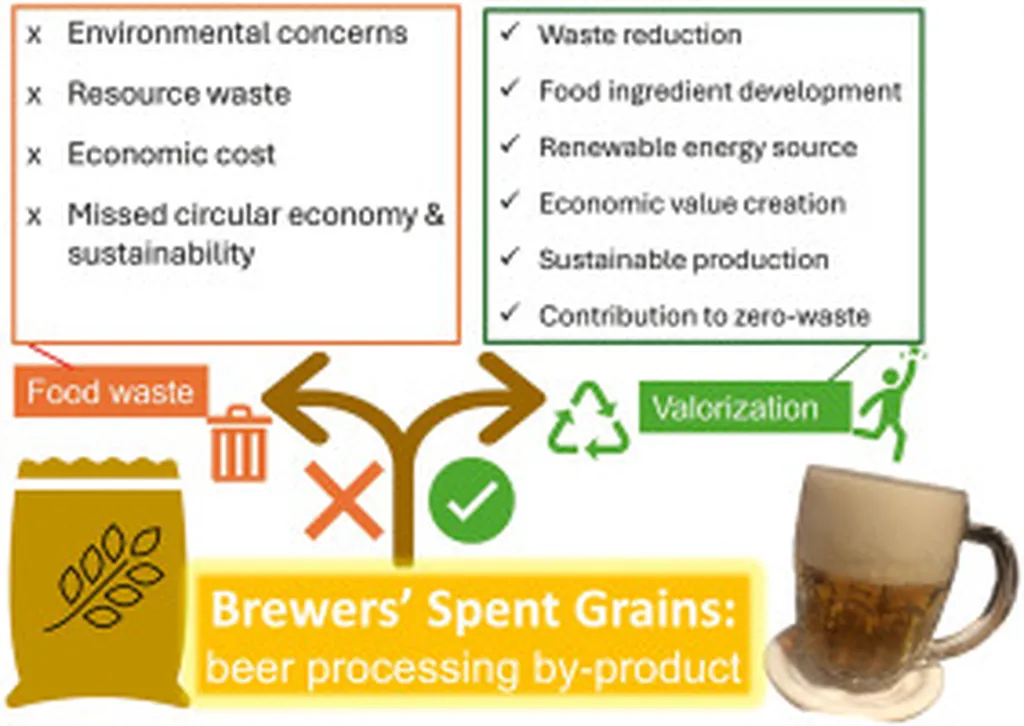
In the quest for sustainable and high-value agricultural byproducts, researchers have made a significant stride by unlocking the potential of brewer’s spent grain (BSG), a often overlooked resource. A recent study published in *Future Foods* demonstrates how this abundant byproduct of beer production can be transformed into a treasure trove of bioactive peptides, offering promising health benefits and commercial opportunities for the agriculture sector.
Brewer’s spent grain, typically discarded as waste, is rich in proteins that can be harnessed to produce bioactive peptides. These peptides have been shown to inhibit angiotensin-converting enzyme (ACE), a key player in regulating blood pressure. By employing a two-stage enzymatic hydrolysis process using Flavourzyme and Alcalase, researchers led by Parichat Paksin from the Faculty of Agro-Industry at Chiang Mai University were able to selectively produce these ACE-inhibitory peptides.
The study revealed that the sequential use of Alcalase followed by Flavourzyme yielded peptides with remarkable bioactivities. “The selective hydrolysis process significantly enhanced the ACE-inhibitory activity, achieving approximately a 1500-fold improvement compared to non-hydrolyzed protein,” Paksin explained. This enhancement was further optimized through membrane ultrafiltration, which separated the peptides into four fractions based on molecular weight. The fraction with the lowest molecular weight (<3 kDa) exhibited the highest ACE-inhibitory activity, highlighting the importance of molecular size in bioactivity.The most active fraction underwent further analysis using size exclusion chromatography and Liquid Chromatography-Tandem Mass Spectrometry to identify the amino acid sequences of the peptides. The identified peptides, rich in hydrophobic residues such as valine, proline, glycine, and leucine, contributed to their ACE-inhibitory properties. "The prevalence of these hydrophobic residues in the peptides suggests a strong potential for their application in health-promoting food products," Paksin noted.The commercial implications of this research are substantial. Brewer's spent grain is a plentiful byproduct of the brewing industry, with millions of tons generated annually. By converting this underutilized resource into high-value bioactive peptides, the agriculture sector can tap into the growing market for functional foods and nutraceuticals. This not only adds economic value to an otherwise discarded byproduct but also aligns with sustainable practices, reducing waste and promoting a circular economy.The findings of this study open up new avenues for innovation in the food and agriculture industries. The integration of enzymatic hydrolysis and fractionation techniques into the manufacturing process can enhance the production of bioactive peptides, making them more accessible for commercial applications. As consumer demand for health-promoting and sustainable food products continues to rise, the development of these peptides from brewer's spent grain presents a promising opportunity for the agriculture sector to meet market needs while contributing to environmental sustainability.In summary, the research led by Parichat Paksin and published in *Future Foods* showcases the potential of brewer's spent grain as a valuable source of bioactive peptides. By leveraging advanced enzymatic and fractionation techniques, the agriculture sector can transform this underutilized byproduct into high-value ingredients, supporting healthy diets and innovative applications in food and nutraceutical products. This study not only highlights the importance of sustainable practices but also paves the way for future developments in the field of functional foods.