
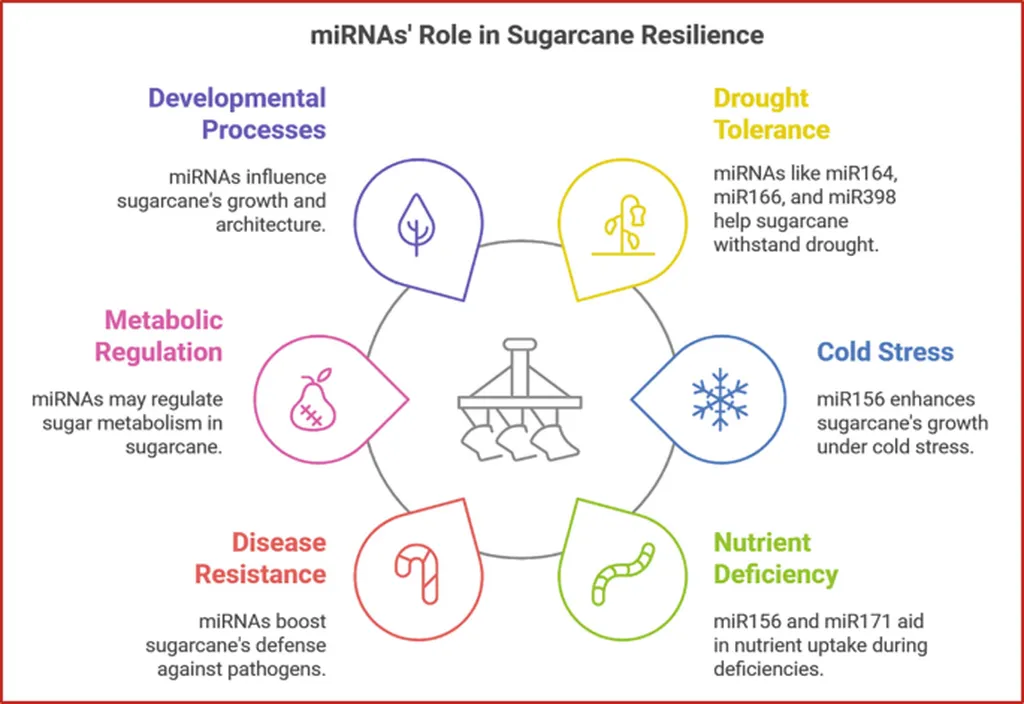
In the quest to bolster sugarcane’s resilience against climate change and environmental stresses, scientists are turning to the intricate world of microRNAs (miRNAs). A recent review published in *Industrial Crops and Products* sheds light on the pivotal role these tiny RNA molecules play in regulating sugarcane’s growth, development, and stress responses. This research could significantly impact the agricultural sector by paving the way for more robust and high-yielding sugarcane varieties.
Sugarcane, a cornerstone crop for sugar production and bioenergy, faces mounting challenges from shifting climates and environmental pressures. Traditional breeding methods, hindered by the crop’s complex genome, have struggled to keep pace. Enter molecular breeding, a precision-driven alternative that hinges on identifying key regulators of desirable traits. MiRNAs, which fine-tune gene expression, have emerged as promising candidates for this role.
“MiRNAs are like molecular switches that can turn genes on or off, influencing a wide range of traits,” explains Miao Wang, lead author of the review and a researcher at the Guangxi Key Laboratory of Sugarcane Genetic Improvement. “Understanding how these switches work in sugarcane can help us develop varieties that are not only high-yielding but also better equipped to handle stress.”
The review, authored by Wang and colleagues, synthesizes recent research on sugarcane miRNAs, offering a comprehensive look at their regulatory roles and the strategies used to validate their target genes. This work represents the first thorough overview of miRNA research in sugarcane, marking a significant step forward in the field.
So, what does this mean for the future of sugarcane farming? By harnessing the power of miRNAs, breeders could potentially develop varieties with enhanced stress tolerance, improved yield, and better quality. This could translate to more stable crop yields, even in the face of adverse conditions, ultimately benefiting farmers and the broader agriculture sector.
Moreover, the review proposes future directions for miRNA research, emphasizing the need for further studies to unravel the complex networks of miRNA-mediated regulation. “There’s still much to learn,” Wang acknowledges. “But the potential is enormous. By continuing to explore these molecular pathways, we can unlock new possibilities for sugarcane improvement.”
As the agriculture sector grapples with the realities of climate change, research like this offers a glimmer of hope. By delving into the microscopic world of miRNAs, scientists are not only unraveling the complexities of sugarcane biology but also charting a course for more sustainable and productive farming practices. The review, published in *Industrial Crops and Products* and led by Miao Wang from the Guangxi Key Laboratory of Sugarcane Genetic Improvement, underscores the transformative potential of miRNA research in shaping the future of sugarcane breeding.