
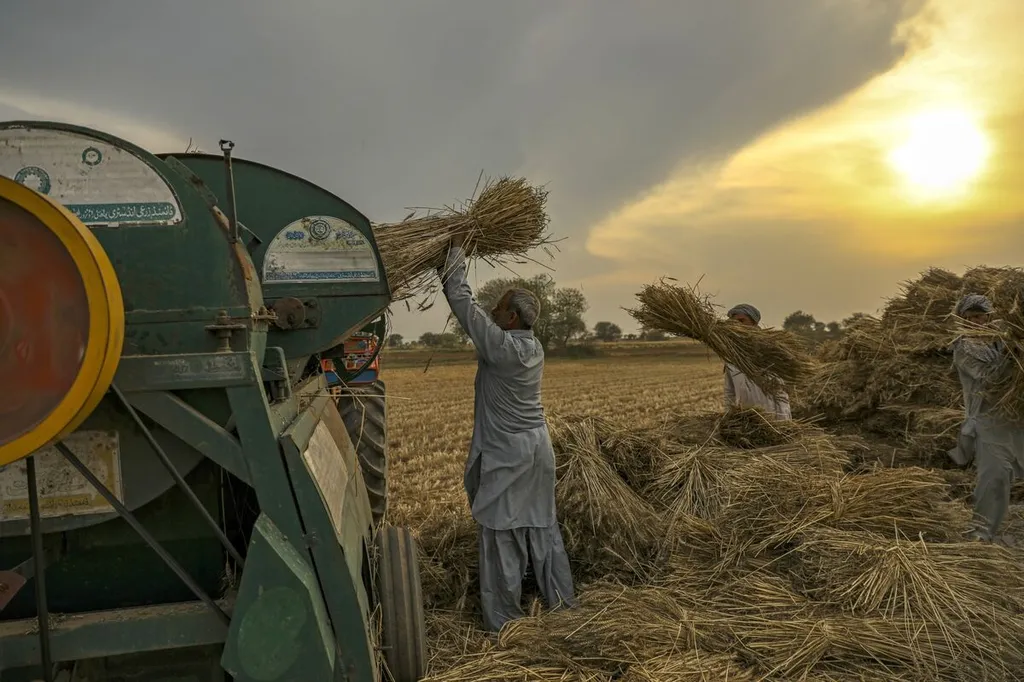
In the heart of Pakistan’s arid regions, a groundbreaking study is reshaping the future of sustainable wheat production, offering a beacon of hope for farmers grappling with drought-induced yield losses. The research, led by Salman Ahmad from the Department of Agronomy at The Islamia University of Bahawalpur, has uncovered a powerful combination of irrigation techniques and mulching strategies that not only enhance wheat yields but also improve water use efficiency and economic returns.
The study, published in the esteemed journal *Agricultural Water Management*, reveals that the traditional approach to irrigation and ground cover is not always the most effective or economical. By comparing two irrigation regimes—conventional and partial root zone drying (PRD)—with four different ground covers, the researchers found that the combination of normal irrigation with black plastic mulch yielded the highest grain output, reaching an impressive 6.00 tonnes per hectare.
However, the most striking finding was the remarkable water use efficiency achieved with PRD irrigation and black plastic mulch, which reached 2.89 kg per hectare per millimeter of water. This discovery could revolutionize wheat farming in arid regions, where water scarcity is a persistent challenge.
“The results were quite surprising,” said lead author Salman Ahmad. “We expected some improvements, but the magnitude of the benefits, both in terms of yield and water efficiency, was beyond our initial projections.”
From a commercial perspective, the findings are equally compelling. The study demonstrated that the highest net field benefits were attained under normal irrigation with black plastics, translating to significant economic gains for farmers. This is a game-changer for the agriculture sector, where profitability often hinges on the ability to maximize yields while minimizing input costs.
The research also highlights the importance of tailored solutions for specific environments. As Ahmad noted, “What works in one region may not necessarily work in another. The key is to understand the local conditions and adapt the techniques accordingly.”
The implications of this study extend far beyond the fields of Pakistan. As global water resources become increasingly strained and climate change exacerbates drought conditions, the need for sustainable and efficient agricultural practices has never been greater. The insights gleaned from this research could pave the way for innovative farming techniques that not only boost productivity but also conserve precious water resources.
In the quest for food security and sustainable agriculture, this study offers a promising path forward. By embracing the findings of Ahmad and his team, farmers and agronomists can take a significant step towards ensuring a more resilient and prosperous future for wheat production in arid regions.