
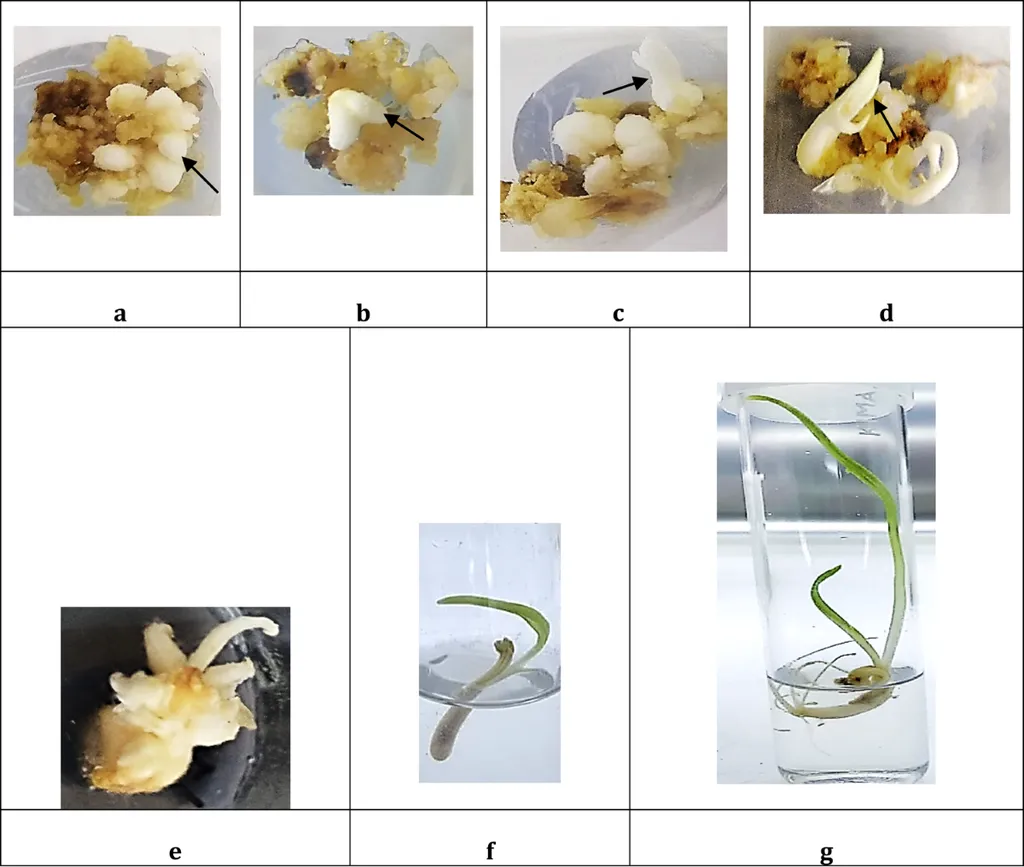
In the world of date palm cultivation, a groundbreaking study has emerged that could revolutionize the way these valuable crops are propagated. Researchers have discovered that using a lower concentration of the plant hormone 2,4-Dichlorophenoxyacetic acid (2,4-D) can significantly enhance the process of indirect embryogenesis, leading to healthier plants and improved genetic stability. This finding, published in the journal *Scientific Reports*, holds promising implications for the agriculture sector, particularly in regions where date palms are a staple crop.
The study, led by Ammar M. A. Ali from the Department of Biology at Hajjah University, systematically evaluated the effects of low (10 mg/L) and high (50 mg/L) concentrations of 2,4-D combined with 3 mg/L of 2iP on callus induction from shoot tip explants of the Barhi date palm variety. The results were striking. Callus induced with the lower concentration of 2,4-D exhibited superior morphogenic competence, yielding a higher fresh weight of callus at both the induction and regeneration stages. This led to a higher frequency of somatic embryos and enhanced regeneration capacity compared to callus induced by the higher concentration.
“This study demonstrates that a lower concentration of 2,4-D can significantly improve the efficiency of date palm micropropagation,” said Ali. “The enhanced callus vigor and subsequent organogenesis not only facilitate a more efficient propagation process but also ensure genetic stability, which is crucial for maintaining the quality and yield of date palm crops.”
The researchers also assessed genetic stability using inter-simple sequence repeat (ISSR) markers. The results confirmed an impressive 97.5% genetic fidelity among all regenerants, indicating that the lower concentration of 2,4-D does not compromise the genetic integrity of the plants. This is a critical finding for the agriculture sector, as genetic stability is essential for maintaining the desired traits of date palm varieties.
The commercial impacts of this research are substantial. Date palms are a valuable crop, not only for their fruit but also for their role in sustainable agriculture and land rehabilitation. An efficient and genetically stable micropropagation protocol can lead to higher yields, improved disease resistance, and better adaptation to various environmental conditions. This can translate into significant economic benefits for farmers and the agriculture industry as a whole.
Moreover, the findings of this study could pave the way for further research into the optimization of plant growth regulators in other crop species. Understanding the delicate balance of these hormones can lead to more efficient and sustainable agricultural practices, ultimately benefiting both producers and consumers.
As the global demand for date palms continues to grow, the need for innovative and efficient propagation methods becomes increasingly important. This research offers a promising solution, one that could shape the future of date palm cultivation and contribute to the broader goals of sustainable agriculture. With the potential to enhance crop yields and ensure genetic stability, this study marks a significant step forward in the field of agritech.