
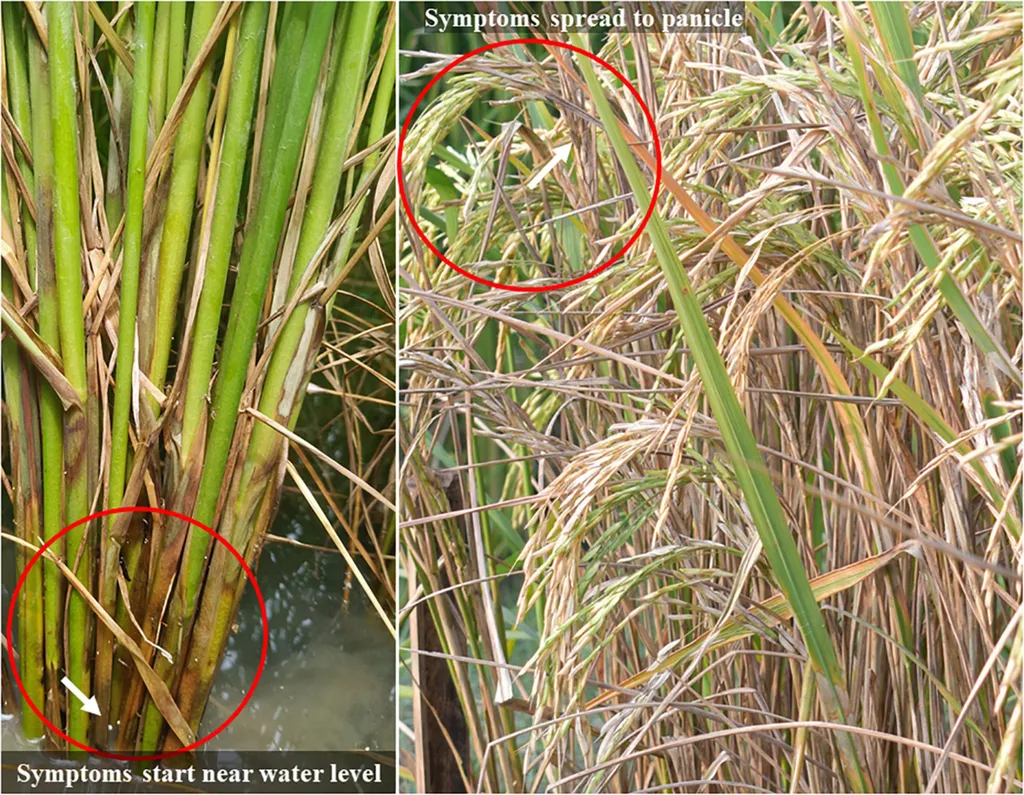
In the relentless pursuit of sustainable agriculture, researchers have turned to nature’s own arsenal to combat one of rice’s most devastating foes: sheath blight. A recent study published in *Technology in Agronomy* has unveiled promising results in using bacterial bioagents to control Rhizoctonia solani, the fungus responsible for sheath blight, which can decimate rice yields by up to 70%.
The study, led by Md Arraf Hasan Reedoy of the Plant Bacteriology & Biotechnology Laboratory at Bangladesh Agricultural University, evaluated 23 bacterial isolates, ultimately identifying four standout performers: BDISO45JoyR and BDISO49JoyR (both Bacillus subtilis), BDISOB219R (Pseudomonas taiwanensis), and BDISOB221R (Pseudomonas sp.). These isolates were formulated with talcum powder and tested under field conditions, with remarkable results.
“Our findings demonstrate that these bacterial bioagents can significantly reduce lesion length and tiller infection, with BDISO45JoyR showing a maximum reduction of 55.25% and 54.80%, respectively,” Reedoy explained. The study also revealed that BDISOB221R promoted the greatest plant height, reaching 116.5 cm, while BDISO45JoyR led to the highest yield increase of 58.51% over the untreated control, translating to 5.28 t/ha.
The implications for the agriculture sector are substantial. Sheath blight poses a significant threat to rice production, and the over-reliance on chemical fungicides has raised concerns about environmental impact and the development of resistant pathogen strains. The use of bacterial bioagents offers a sustainable and effective alternative, potentially revolutionizing disease management in rice cultivation.
As the global population continues to grow, the demand for food security intensifies. Innovations like these bacterial bioagents could play a pivotal role in enhancing crop yields and ensuring stable food supplies. Moreover, the success of this study opens doors for further research into bioagents for other crops and diseases, paving the way for a more sustainable and resilient agricultural future.
Reedoy’s research, published in *Technology in Agronomy*, not only highlights the potential of bacterial bioagents but also underscores the importance of exploring nature’s own solutions to agricultural challenges. As the world seeks to balance productivity with sustainability, such breakthroughs offer hope and promise for the future of farming.