
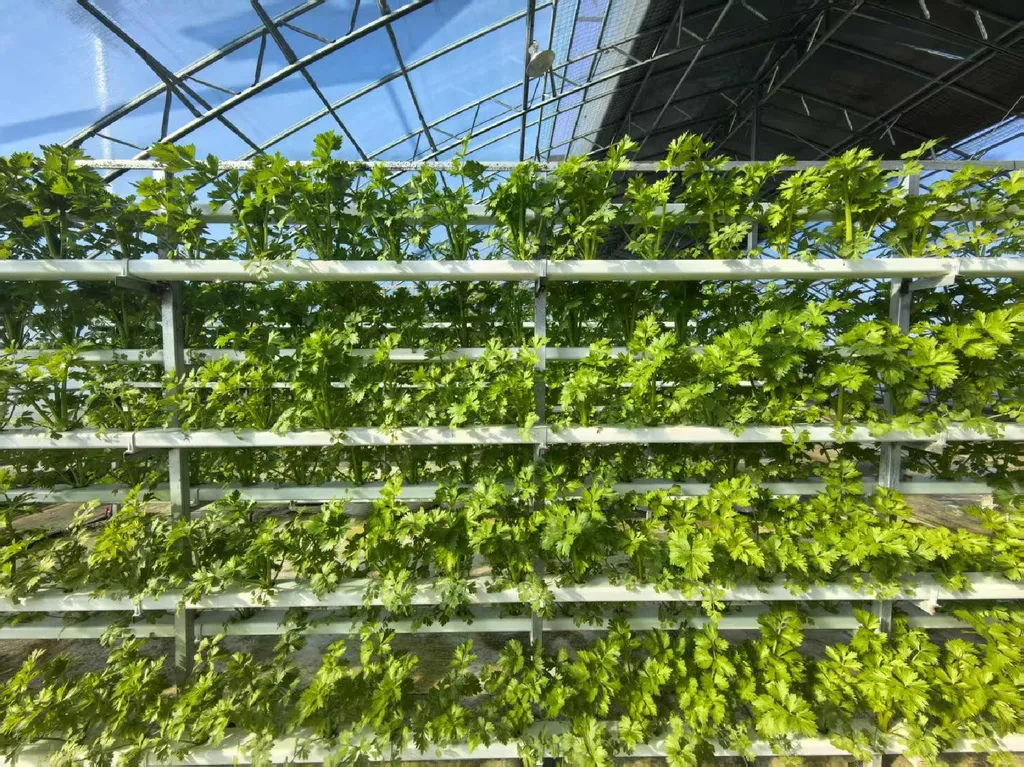
In the heart of Jiangsu, China, a revolution in celery cultivation is taking root, quite literally. Researchers have developed a simple, rapid, and efficient hydroponic cultivation technique for celery on elevated racks, promising to transform the way we grow this versatile vegetable. The study, published in *Technology in Horticulture*, offers a beacon of hope for farmers grappling with the challenges of traditional soil-based cultivation.
Celery cultivation has long been plagued by issues such as low fertilizer utilization, continuous cropping obstacles, and frequent pest and disease outbreaks. These problems not only hinder the growth of the plants but also pose significant economic challenges for farmers. The new hydroponic technique, developed by a team led by Wen-Hui Zhang from the State Key Laboratory of Crop Genetics & Germplasm Enhancement and Utilization at Nanjing Agricultural University, aims to address these very issues.
The innovative method involves using a steel frame with polyvinyl chloride cultivation troughs to support a nutrient film technique circulation system. This setup allows for a more controlled and efficient growth environment. “Before sowing, the celery seeds are soaked in warm water, and then they are planted in a 128-cell seedling substrate,” explains Zhang. “When the celery seedlings have grown about five leaves, they are transplanted. After transplantation, the celery plants should be cultivated with a nutrient solution with an EC value of 1.0 to 1.5 mS/cm and a pH value of 5.7 to 7.0.”
One of the most significant advantages of this hydroponic technique is its ability to produce high yields with fewer resources. The system can produce over 12,000 kg of celery per 667 m2 annually, with a net income of over CNY16,000 per year. This represents a 45% increase in yield compared to traditional soil cultivation methods. “This technology can increase the yield by 45% compared with local soil cultivation,” says Zhang. “It provides a technical reference for the simplified and efficient production of celery in protected areas in Jiangsu and other regions.”
The commercial impacts of this research are substantial. Farmers can look forward to higher yields, reduced pesticide use, and lower operational costs. The technique’s simplicity and efficiency make it an attractive option for both small-scale and large-scale farmers. Moreover, the ability to grow celery year-round and multiple times a year can significantly boost economic returns.
The implications of this research extend beyond celery cultivation. The principles and techniques developed in this study could be applied to other leafy greens and vegetables, paving the way for a more sustainable and efficient future for the agriculture sector. As the world grapples with the challenges of climate change and resource scarcity, innovative solutions like this hydroponic technique offer a glimmer of hope.
In the words of Wen-Hui Zhang, “This technology can increase the yield by 45% compared with local soil cultivation. It provides a technical reference for the simplified and efficient production of celery in protected areas in Jiangsu and other regions.” These words encapsulate the essence of this groundbreaking research and its potential to shape the future of agriculture.