
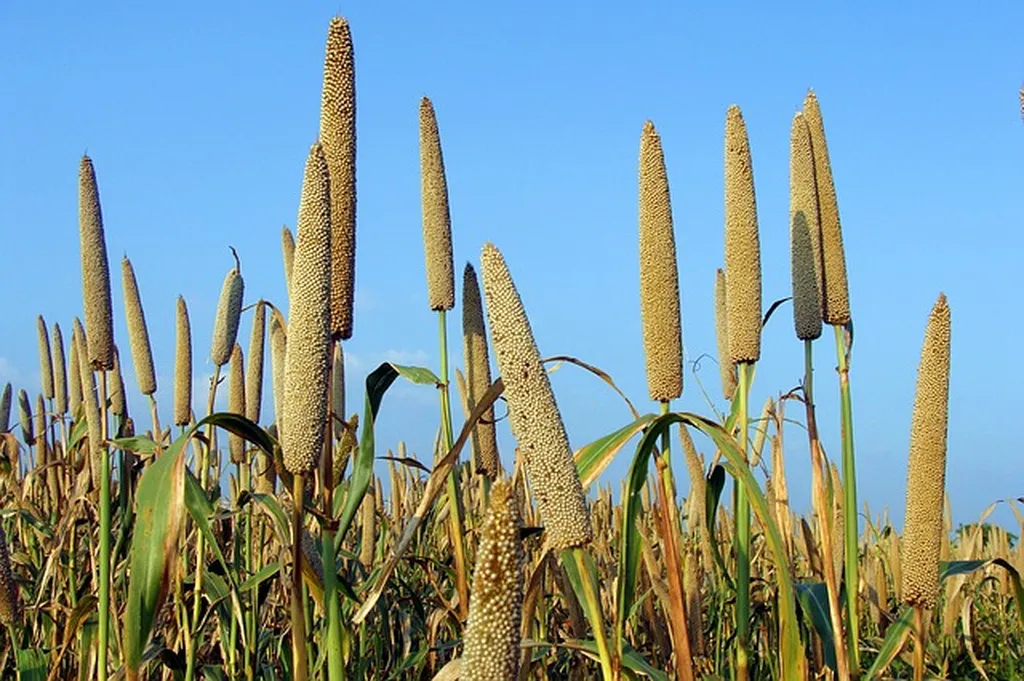
In the heart of agricultural innovation, a recent study published in *Grass Research* has uncovered critical insights into the genetic mechanisms that could bolster pearl millet’s resilience against environmental stresses. Pearl millet, a staple crop for food, fodder, and biofuel, often faces productivity challenges due to abiotic stresses like drought, heat, and salinity. The research, led by Atiqa Najeeb from the College of Grassland Science and Technology at Sichuan Agricultural University, delves into the basic helix-loop-helix (bHLH) transcription factor family, a key player in plant stress responses.
The study identified 110 PgbHLH transcription factors (TFs) in pearl millet, classifying them into 12 subfamilies with 20 conserved motifs. “The structural analysis showed that PgbHLH proteins within each subgroup were relatively conserved, indicating a stable evolutionary history,” Najeeb explained. This conservation suggests that these genes have maintained their functions over time, providing a reliable foundation for genetic engineering efforts.
Phylogenetic analysis revealed the distribution of PgbHLH genes across all seven chromosomes of pearl millet. Evolutionary comparisons with Arabidopsis thaliana and Oryza sativa highlighted distinct orthologous and paralogous genes, offering clues about gene functions in related species. “Collinearity analysis showed both the conservation of PgbHLH genes across multiple plant species and their collinear divergence based on gene order and similarity metrics,” Najeeb added. This insight into the functional evolution of the bHLH gene family could pave the way for more targeted breeding programs.
One of the most promising findings was the identification of stress-responsive cis-regulatory elements (CREs) in the PgbHLH promoters. These elements, which account for 34% of all identified CREs, are crucial for regulating gene expression under stress conditions. In-silico expression profiling further demonstrated the diverse regulatory roles of PgbHLH genes in leaf and root tissues under heat, drought, and salt stress, highlighting their potential for enhancing crop resilience.
The commercial implications of this research are substantial. Pearl millet is a vital crop in arid and semi-arid regions, where abiotic stresses are common. By understanding and manipulating the bHLH TFs, agricultural scientists can develop pearl millet varieties that are more resilient to environmental challenges. This could lead to increased crop yields and improved food security in regions where pearl millet is a dietary staple.
Moreover, the insights gained from this study could extend beyond pearl millet. The conservation of PgbHLH genes across multiple plant species suggests that similar strategies could be applied to other crops, potentially revolutionizing agricultural practices worldwide. “This study provides a valuable resource for future functional validation studies aimed at improving abiotic stress resilience in pearl millet through molecular breeding,” Najeeb concluded.
As the agricultural sector continues to grapple with the impacts of climate change, research like this offers a beacon of hope. By harnessing the power of genomics and molecular biology, scientists are paving the way for a more resilient and sustainable future in agriculture. The study, led by Atiqa Najeeb and published in *Grass Research*, stands as a testament to the potential of modern agricultural research to drive meaningful change in the field.