
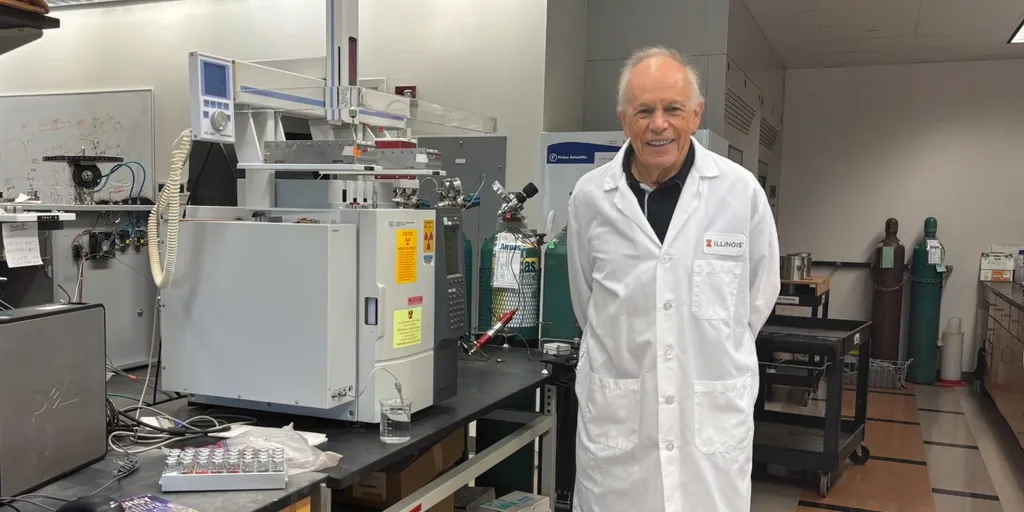
In the world of agritech, where science and agriculture intersect, the recent passing of Professor Stephen P. Long, FRS, has left a significant void. A pioneer in the field, Long’s contributions to crop science and bioenergy research have paved the way for innovative solutions to global food and energy security. His work, particularly in enhancing photosynthesis and improving crop yields, has had a profound impact on the agriculture sector, offering promising avenues for sustainable development.
Long’s research focused on understanding and manipulating the process of photosynthesis to create crops that could yield more food and fuel with fewer resources. This approach, known as “synthetic biology,” has the potential to revolutionize agriculture by creating crops that are more resilient to environmental stresses and capable of producing higher yields. As Long once stated, “By understanding the fundamental processes that underpin plant growth, we can develop crops that are not only more productive but also more sustainable.”
The commercial implications of Long’s work are vast. In an era where the global population is projected to reach 9.7 billion by 2050, the demand for food and energy is set to skyrocket. Long’s research offers a beacon of hope, providing a roadmap for developing crops that can meet these growing demands without compromising the environment. This is particularly relevant for the agriculture sector, which is under increasing pressure to adopt sustainable practices that minimize environmental impact.
One of the key areas where Long’s research has had a significant impact is in the development of bioenergy crops. These crops, which are specifically designed for energy production, have the potential to provide a sustainable and renewable source of energy. As the world seeks to transition away from fossil fuels, the development of bioenergy crops could play a crucial role in meeting global energy demands.
The recent article published in ‘GCB Bioenergy’, led by Lorenzo Álvarez‐Filip from the Biodiversity and Reef Conservation Laboratory at the Universidad Nacional Autónoma de México, highlights the ongoing relevance of Long’s work. The article explores the potential of bioenergy crops to contribute to a sustainable energy future, building on the foundations laid by Long’s research.
Looking ahead, the future of agritech is likely to be shaped by the principles and discoveries championed by Professor Long. As the agriculture sector continues to evolve, the integration of synthetic biology and advanced plant science will be crucial in developing crops that are not only more productive but also more resilient to the challenges posed by climate change and environmental degradation.
In conclusion, Professor Stephen P. Long’s legacy in the field of agritech is one of innovation and inspiration. His work has laid the groundwork for a future where agriculture is not only more productive but also more sustainable. As we continue to grapple with the challenges of feeding and energizing a growing global population, the principles and discoveries championed by Long will be more important than ever.