
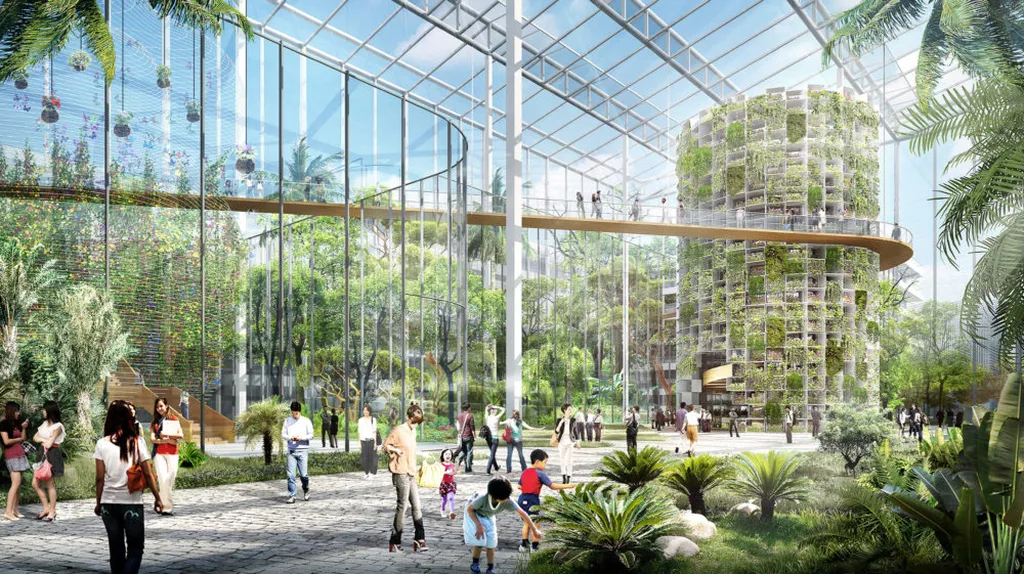
In the heart of Shanghai, a team of researchers led by Junye Wu from the Research Center of Solar Power and Refrigeration at Shanghai Jiao Tong University, along with collaborators from the National University of Singapore, is redefining the future of agriculture. Their work, recently published in the journal *Engineering*, presents a design for vertical farming systems that are not only environmentally friendly but also economical and modular. This innovation could significantly impact the agriculture sector, particularly in urban areas where space is limited, and food security is a growing concern.
Vertical farming, the practice of growing crops in vertically stacked layers, is not new. However, the team’s approach integrates several cutting-edge technologies to optimize plant growth and minimize environmental impact. At the core of their design is a carbon dioxide (CO2)-enriched atmosphere, achieved through direct air capture (DAC). This process involves capturing CO2 directly from the ambient air, which is then used to enhance plant growth. “By enriching the atmosphere with CO2, we can significantly increase the productivity of our vertical farms,” explains Wu. “In our experiments, we observed an increase in the fresh weight of vegetables by up to 57.5% compared to the control group.”
The team’s vertical farming setup also incorporates artificial light exposure, biochar application, and a self-developed DAC rotary adsorber to ensure stable and efficient CO2 enrichment. Biochar, a carbon-rich product derived from the pyrolysis of biomass, improves soil health and enhances plant growth. Meanwhile, the DAC rotary adsorber efficiently captures CO2 from the air, providing a sustainable source of this essential plant nutrient.
One of the most notable aspects of this research is its economic viability. The team performed a comprehensive evaluation of their design and found that integrating photovoltaic-thermal (PVT) and DAC units increased the system’s net present value (NPV) by 157% compared to a conventional design without these units. PVT systems combine photovoltaic cells and solar thermal collectors to generate both electricity and heat, making them an efficient and sustainable energy solution.
The environmental benefits of this design are equally impressive. The team demonstrated that it is possible to maintain a low carbon footprint (0.468 kg-CO2 equivalent per kg of vegetable) throughout the production process. This is a significant achievement, as reducing the environmental impact of food production is a key challenge in sustainable agriculture.
The adaptability of this strategy to diverse conditions is another crucial factor. Parametric studies and global-scale application analyses reveal that the design can be tailored to suit various climates and resource availability. This flexibility makes it a promising solution for food security in both developed and developing countries.
The commercial implications of this research are substantial. As urbanization continues to rise, the demand for locally grown, fresh produce will increase. Vertical farming systems that are economical, environmentally friendly, and modular can meet this demand while reducing the environmental footprint of agriculture. Moreover, the integration of DAC and PVT technologies can create new business opportunities in the renewable energy and carbon capture sectors.
This research is a significant step toward sustainable agriculture. As Wu notes, “Our findings highlight the promising potential of this design to increase food security and foster sustainable agriculture.” The modular characteristics of the vertical farming systems make them adaptable to various scales, from small urban farms to large-scale agricultural operations. This flexibility, combined with the economic and environmental benefits, could revolutionize the agriculture sector and contribute to a more sustainable future.
The work of Junye Wu and his team, published in *Engineering*, offers a glimpse into the future of agriculture. By integrating advanced technologies and sustainable practices, they have developed a design that addresses the pressing challenges of food security and environmental sustainability. As the world grapples with the impacts of climate change and urbanization, innovations like these will be crucial in shaping a more resilient and sustainable future.