
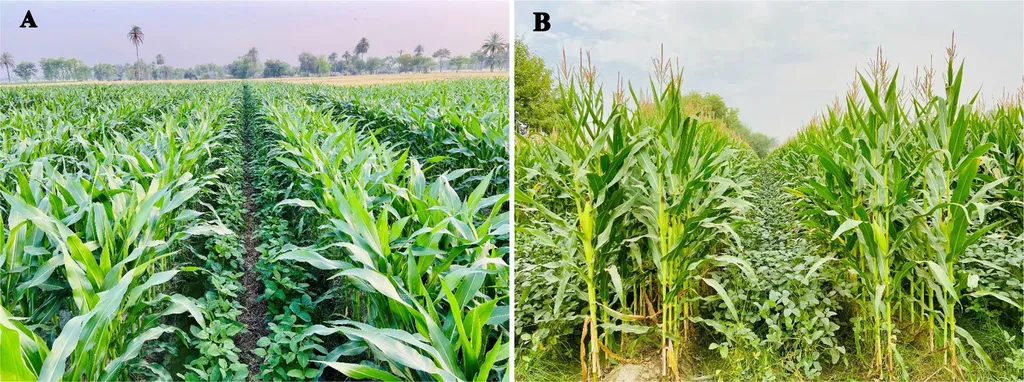
In the ever-evolving landscape of agriculture, the integration of genetically modified (GM) crops and innovative planting patterns is opening new avenues for enhanced productivity and sustainable pest management. A recent study published in the journal ‘Agronomy’ sheds light on the promising synergy between GM maize and soybean and strip intercropping, offering valuable insights for the agriculture sector.
The research, led by Wanxuan Zhao from the State Key Laboratory for Biology of Plant Diseases and Insect Pests at the Chinese Academy of Agricultural Sciences, evaluated eight different planting patterns, including monocultures and strip intercropping integrations of insect-resistant GM maize (‘RF88’) and soybean (CAL16) events, along with their non-transgenic counterparts. Conducted over three years in the Huang-Huai-Hai planting area, the study identified *Helicoverpa armigera* and *Spodoptera exigua* as the dominant pests on maize and soybean, respectively.
The findings revealed that the GM trait significantly reduced the population density and plant damage caused by these pests. Moreover, strip intercropping provided additional suppression across both crop lines. The integration of strip intercropping and the GM trait proved to be the most effective pest control strategy. “The combination of GM traits and strip intercropping not only enhances pest resistance but also optimizes resource utilization, paving the way for more sustainable and efficient agricultural practices,” Zhao noted.
The commercial implications of this research are substantial. As the commercialization of GM maize and soybean advances, the adoption of strip intercropping could offer farmers a robust tool to manage pests while improving crop yields and resource efficiency. This integrated approach could be particularly beneficial in regions where pest pressure is high, helping to reduce the reliance on chemical pesticides and promoting more environmentally friendly farming practices.
The study also highlights the importance of top-level design and industrial layout in the commercialization of GM crops. By understanding the interactions between GM traits and different planting patterns, stakeholders can make informed decisions that maximize the benefits of these advanced agricultural technologies.
As the agriculture sector continues to grapple with the challenges of feeding a growing population while minimizing environmental impact, research like this provides a beacon of hope. The integration of GM crops and innovative planting patterns offers a glimpse into a future where agriculture is not only more productive but also more sustainable. “This research contributes to promoting the safe application and sustainable pest management of GM crops, which is crucial for the future of agriculture,” Zhao added.
In the quest for sustainable and efficient agricultural practices, the synergy between GM crops and strip intercropping emerges as a promising strategy. As the agriculture sector continues to evolve, the insights gained from this research could shape the development of new technologies and practices, ultimately benefiting farmers and consumers alike.