
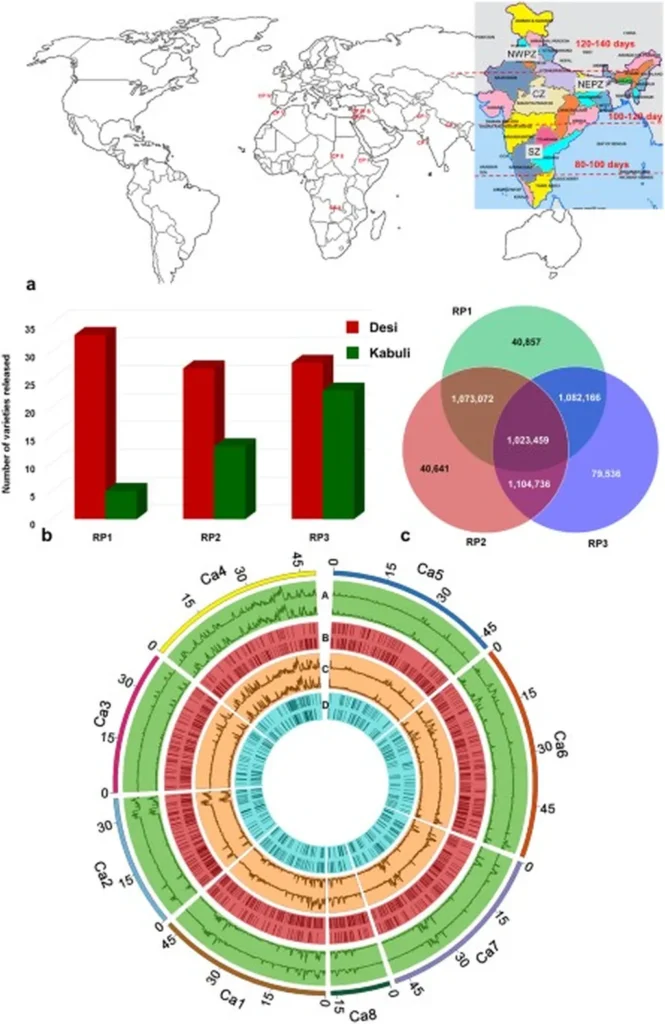
In the heart of agricultural innovation, a groundbreaking study has emerged, offering a deeper understanding of genetic diversity in chickpeas and paving the way for more resilient and productive crop varieties. Published in ‘The Plant Genome’, this research, led by Pradeep Ruperao from the Global Research Program at the International Crops Research Institute for the Semi-Arid Tropics (ICRISAT) in Hyderabad, India, employs a multi-marker approach to unravel the genetic tapestry of chickpeas, encompassing desi, kabuli, and wild accessions.
The study harnesses the power of whole genome re-sequencing data from 593 select chickpea genotypes, revealing a treasure trove of genetic variations. With over 21 million single nucleotide polymorphisms (SNPs), 10 million insertions and deletions (indels), and 16,117 presence/absence variations (PAVs), the research provides an unprecedented glimpse into the genetic diversity of chickpeas. “This comprehensive analysis allows us to capture a broader range of genetic diversity within and between desi, kabuli, and wild accessions, as well as landraces, cultivars, and breeding lines,” explains Ruperao.
The implications for the agriculture sector are profound. By identifying novel alleles and gene variations, this research offers effective breeding strategies for key traits such as yield, and biotic and abiotic stress tolerance. “The identified marker-trait associations can significantly contribute to chickpea improvement, paving the way for the development of more resilient varieties,” Ruperao adds.
The use of multiple marker types in this study represents a powerful strategy for diversity analysis and genome-wide association studies (GWAS). This approach not only enhances our understanding of genetic diversity but also provides a robust framework for future breeding programs. The study’s emphasis on balanced population design and the use of diverse marker types sets a new standard for genetic research in crop improvement.
As we look to the future, this research holds the potential to shape the development of more resilient and productive chickpea varieties. By leveraging the genetic diversity identified in this study, breeders can develop crops that are better equipped to withstand environmental stresses and deliver higher yields. This, in turn, can contribute to food security and economic stability in regions where chickpeas are a staple crop.
In the ever-evolving landscape of agricultural technology, this study stands as a testament to the power of genetic research in driving innovation and progress. As we continue to explore the genetic potential of our crops, we move closer to a future where agriculture is not only more productive but also more sustainable and resilient.