
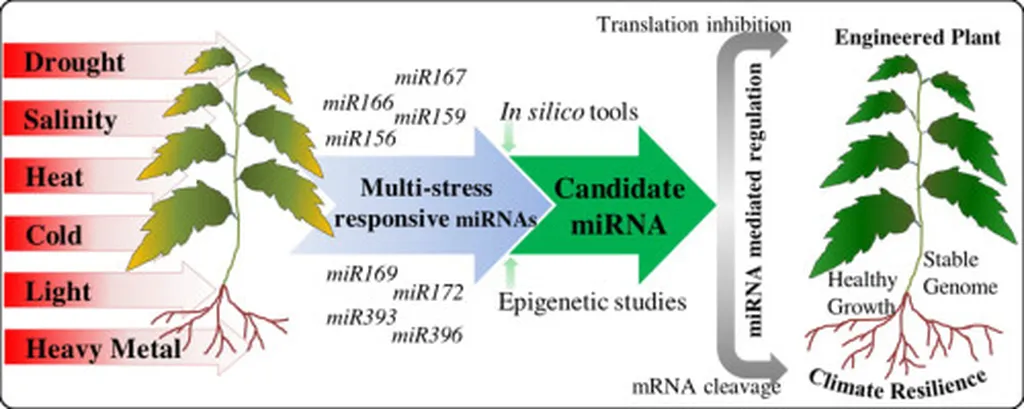
In the face of escalating global temperatures, scientists are turning to the microscopic world of microRNAs (miRNAs) to uncover new ways of safeguarding our crops. A recent review published in *The Plant Genome* sheds light on how these tiny molecules could hold the key to developing heat-resilient plants, offering a glimmer of hope for farmers grappling with the realities of climate change.
Heat stress is a formidable adversary in agriculture, stunting growth, hampering reproduction, and slashing yields. But within this challenge lies an opportunity, as researchers delve into the intricate dance of miRNAs and their role in helping plants cope with soaring temperatures. “Understanding how miRNAs regulate gene expression in response to heat stress is crucial for developing crops that can withstand the pressures of a warming world,” explains lead author Muhammad Farooq from the Centre of Agricultural Biochemistry and Biotechnology at the University of Agriculture Faisalabad in Pakistan.
The review, led by Farooq, explores how miRNAs fine-tune the expression of genes involved in critical plant functions, from hormone signaling to oxidative stress mitigation. By targeting specific genes, miRNAs help plants navigate the treacherous terrain of heat stress, ensuring their survival and productivity. Among the miRNAs identified as key players are miR156, miR398, and miR172, which regulate a cascade of responses that bolster a plant’s defenses against heat.
The implications for agriculture are profound. As climate change continues to push temperatures higher, the need for heat-resilient crops becomes ever more urgent. By harnessing the power of miRNAs, scientists may be able to engineer plants that can thrive in even the most challenging environments. “This research opens up exciting possibilities for developing crops that are not only more resilient to heat but also more productive,” Farooq says.
The review also highlights the complex networks in which miRNAs operate, including their interactions with other types of RNA, such as small interfering RNAs, long noncoding RNAs, and circular RNAs. These interactions form a intricate web of regulation, with miRNAs acting as central hubs that integrate signals from various sources to orchestrate the plant’s response to heat stress.
However, the journey towards miRNA-based crop engineering is not without its hurdles. The review underscores the need for a deeper understanding of tissue-specific miRNA dynamics and their integration with epigenetic and multi-omics networks. To fully realize the potential of miRNAs in agriculture, researchers must adopt integrative approaches that combine cutting-edge technologies with innovative strategies.
As the world grapples with the consequences of climate change, the search for sustainable solutions has never been more pressing. The insights gleaned from this review offer a tantalizing glimpse into a future where miRNAs could play a pivotal role in securing our food supply. By unraveling the mysteries of these tiny molecules, scientists are paving the way for a new era of climate-resilient agriculture, one that can weather the storms of a warming world.
The review, published in *The Plant Genome*, was led by Muhammad Farooq from the Centre of Agricultural Biochemistry and Biotechnology at the University of Agriculture Faisalabad in Pakistan. As researchers continue to explore the complexities of miRNA-mediated heat stress regulation, the promise of heat-resilient crops grows ever brighter, offering hope for farmers and food security in an uncertain climate.