
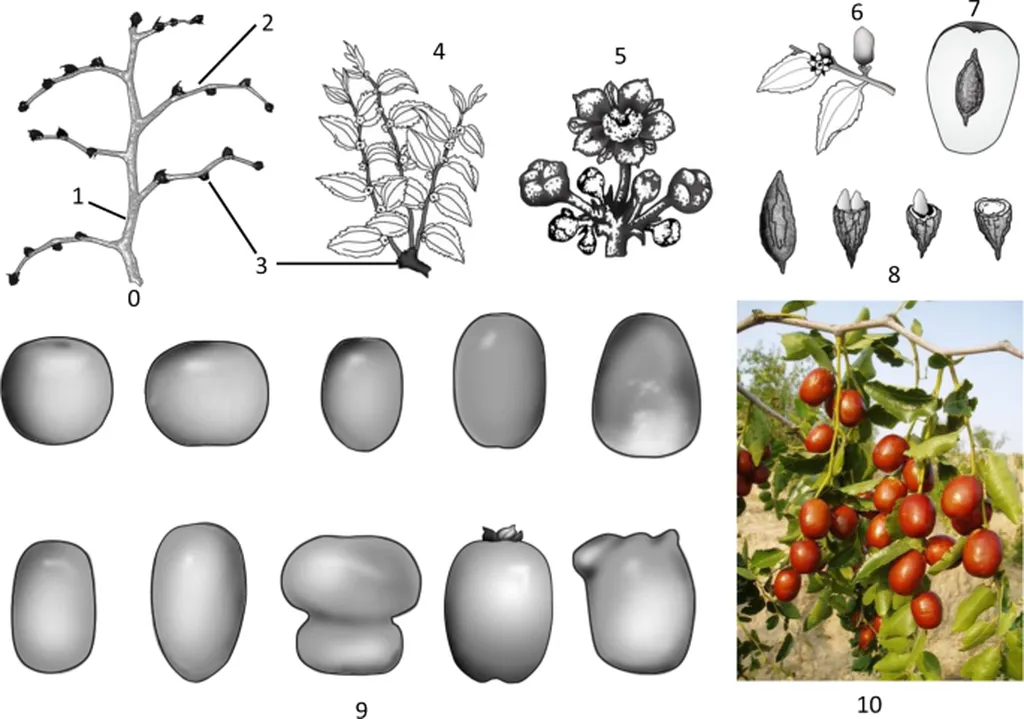
In the heart of agricultural innovation, a recent study has shed light on the genetic diversity of Ziziphus mauritiana, commonly known as Indian jujube, offering promising avenues for breeding and nutritional improvement. Published in *Notulae Botanicae Horti Agrobotanici Cluj-Napoca*, the research led by Nora M. Al ABOUD from Umm Al-Qura University, delves into the biochemical and molecular markers of 15 genotypes of Z. mauritiana, revealing substantial variations that could revolutionize the agriculture sector.
The study evaluated key phytochemical attributes such as total soluble solids (TSS), total sugars, vitamin C, antioxidant activity, and total phenolics. The findings were striking: TSS ranged from 9.45 to 14.52 °Brix, with genotypes ‘G14’ and ‘G13’ showing the highest values. Total sugars varied from 7.25 to 10.53 g/100 g, and vitamin C content spanned from 29.47 to 68.53 mg/100 g. Notably, genotype ‘G13’ exhibited the highest antioxidant activity at 39.65%, while ‘G5’ peaked in total phenolics with 252.35 mg GAE/100 g.
Principal Component Analysis (PCA) identified genotypes ‘G3’, ‘G5’, ‘G6’, ‘G10’, and ‘G13’ as superior in terms of sweetness, antioxidants, and secondary metabolites. This genetic diversity is a goldmine for breeders aiming to enhance the nutritional profile of Z. mauritiana.
On the molecular front, the study employed Start Codon Targeted (SCoT) markers, generating 112 bands, of which 67 were polymorphic. The SCoT-2 marker stood out with a polymorphism rate of 78.26%, indicating moderate genetic diversity among the genotypes. Population structure and Principal Coordinates Analysis (PCoA) revealed two major genetic clusters, with some genotypes showing admixture, suggesting shared ancestry or gene flow.
“The correlation matrix among phytochemical attributes displayed a positive relation between TSS and sugars with antioxidant activity, which is crucial for developing functional foods,” noted Al ABOUD. This positive correlation is a significant finding, as it highlights the potential to breed genotypes that are not only sweeter but also more nutritious.
The implications for the agriculture sector are profound. By identifying genetically superior genotypes, breeders can develop high-yielding, nutrient-rich varieties of Z. mauritiana. This could enhance the commercial value of the crop, opening new markets for functional foods and nutritional supplements. Moreover, understanding the genetic diversity and structure of Z. mauritiana can aid in conservation efforts, ensuring the preservation of valuable genetic resources.
As the global demand for nutritious and functional foods continues to rise, this research provides a valuable roadmap for future breeding programs. It underscores the importance of integrating biochemical and molecular markers in crop improvement strategies, paving the way for a more sustainable and productive agriculture sector.
In the words of Al ABOUD, “This study is a stepping stone towards unlocking the full potential of Ziziphus mauritiana, benefiting both farmers and consumers alike.” With such insights, the future of agricultural innovation looks promising indeed.