
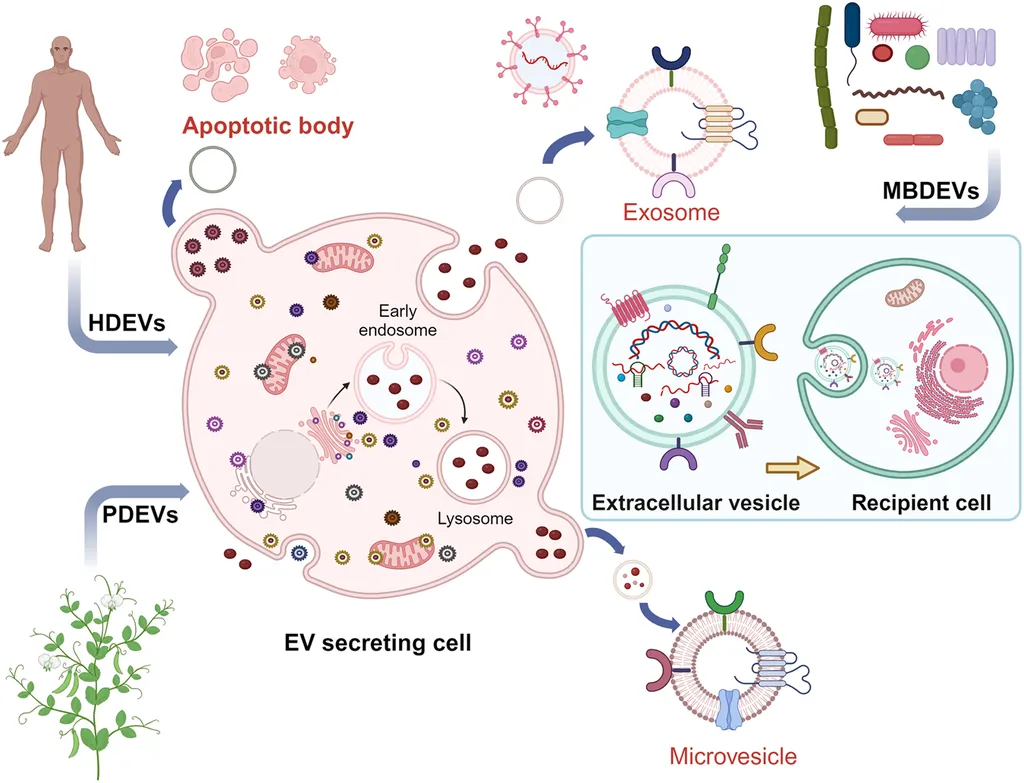
In the quest to combat inflammatory bowel disease (IBD), a groundbreaking study published in *Signal Transduction and Targeted Therapy* offers a glimmer of hope. Researchers, led by Mi-Kyung Oh from the Department of Agricultural Biotechnology and Research Institute of Agriculture and Life Sciences at Seoul National University, have developed a novel bioengineered extracellular vesicle (EV) platform that could revolutionize IBD treatment. This innovative approach targets key immune signaling pathways, offering a more precise and effective therapy with fewer side effects.
The current therapies for IBD often fall short, failing to achieve complete remission and causing systemic toxicity due to their broad immunosuppressive effects. The new study introduces a dual-targeting EV derived from Wharton’s jelly mesenchymal stem cells, engineered to display PD-L1 on its surface and encapsulate miR-27a-3p. This dual-action mechanism addresses the root causes of IBD by modulating T-cell activity and reducing inflammation.
PD-L1 on the EV surface engages the PD-1 checkpoint in activated T cells, attenuating T-cell receptor signaling. Simultaneously, miR-27a-3p suppresses prohibitin 1 (PHB1), a mitochondrial regulator that influences Th17 cell bioenergetics and inflammatory function. This suppression reduces Th17 polarization and increases the number of FOXP3⁺ regulatory T cells, thereby restoring the balance of T cells in inflamed intestinal tissues.
The study’s lead author, Mi-Kyung Oh, explained, “Our engineered EVs preferentially localized to inflamed intestinal tissues via chemokine (CCR2/CXCR4) and PD-1-dependent mechanisms. This targeted approach ensures that the therapy acts precisely where it is needed, minimizing systemic side effects.”
The implications for the agriculture sector are significant. IBD not only affects human health but also has economic repercussions, particularly in livestock farming where similar inflammatory conditions can impact animal productivity and welfare. The development of targeted, cell-free immunotherapies could pave the way for similar treatments in veterinary medicine, enhancing animal health and productivity.
In humanized mouse models of colitis, the dual-targeting EVs attenuated mucosal inflammation, suppressed effector T-cell responses, and preserved epithelial integrity. In IBD patient-derived colonoid cultures, the EVs maintained epithelial viability and barrier integrity without inducing cytotoxicity or structural disruption. Transcriptomic and single-cell analyses revealed the downregulation of inflammatory and exhaustion signatures, along with the enrichment of regulatory subsets.
This research presents a promising therapeutic strategy for IBD and other T cell-driven inflammatory disorders. The targeted approach not only improves treatment efficacy but also reduces the risk of systemic toxicity, offering a safer and more effective solution for patients. As Mi-Kyung Oh noted, “This study opens new avenues for developing precision immunotherapies that can be tailored to specific inflammatory conditions, both in humans and animals.”
The findings could shape future developments in the field of immunotherapies, particularly in agriculture, where maintaining animal health is crucial for sustainable farming practices. By addressing the underlying immune mechanisms of inflammatory diseases, this research could lead to innovative treatments that enhance animal welfare and productivity, ultimately benefiting the entire agricultural sector.