
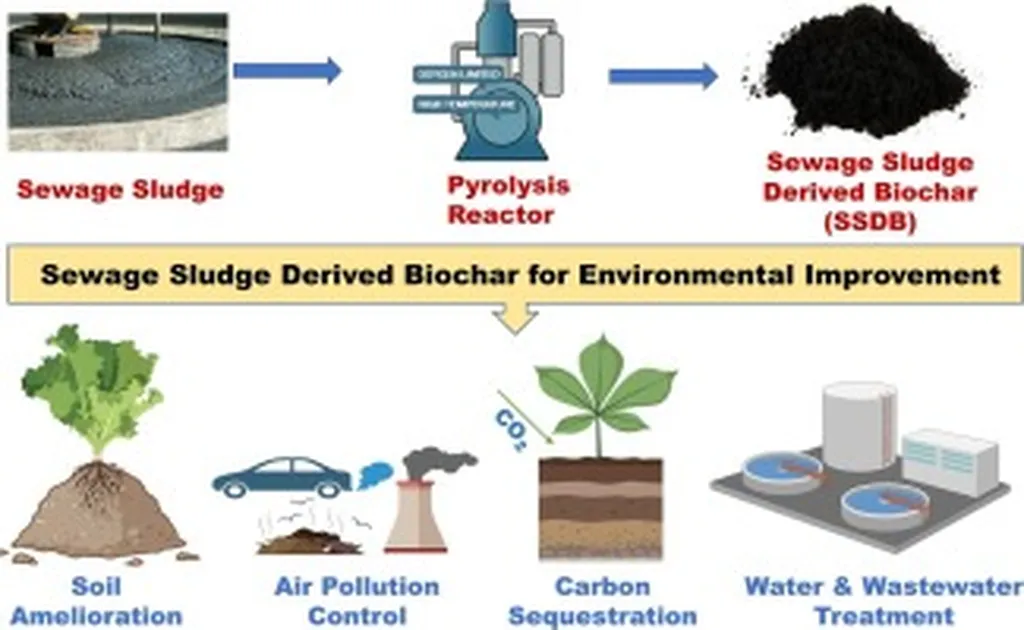
In the quest to address pesticide contamination in agricultural soils, a novel approach using sewage sludge-derived biochar (SB) has shown promising results, offering a potential solution that not only immobilizes contaminants but also supports soil health. This innovative method, detailed in a recent study published in *Applied Biological Chemistry*, could significantly impact the agriculture sector by providing a sustainable remediation strategy.
The research, led by Ji Won Yang from the Department of Agricultural Biotechnology at Seoul National University, focuses on the adsorption of tricyclazole (TCZ), a commonly used pesticide, using biochar derived from sewage sludge. The study found that when pyrolyzed at 700°C for one hour, SB demonstrated an effective adsorption capacity for TCZ, particularly under mildly acidic conditions (pH 4–6). This finding is crucial for agricultural soils, which often face elevated levels of pesticide contamination.
“Our study reveals that sewage sludge biochar can effectively adsorb tricyclazole, which is a significant step forward in managing pesticide contamination in agricultural settings,” said Ji Won Yang. “Moreover, the biochar’s ability to mitigate TCZ-induced changes in microbial community structure suggests that it can play a dual role in both remediation and soil health restoration.”
The adsorption process was found to occur primarily through physical mechanisms such as π–π interactions, hydrophobic partitioning, and pore filling, with surface functional groups playing a smaller role. This insight is vital for understanding the underlying processes and optimizing the use of SB in real-world applications.
In soil microcosm experiments, the addition of SB alongside TCZ helped maintain the relative abundance of several genera involved in nitrogen, carbon, and phosphorus cycling. However, certain nitrifier-associated groups remained reduced, indicating that while SB can mitigate some TCZ-related disruptions, further research is needed to fully understand its impact on soil microbial communities.
The study also observed temporary reductions in alkaline phosphatase and N-acetyl-β-D-glucosaminidase activities when SB and TCZ were added to soil. These reductions were likely due to matrix effects such as substrate sorption and metal interactions rather than direct TCZ toxicity. This finding underscores the importance of carefully monitoring heavy metal input when using SB amendments.
The commercial implications of this research are substantial. As the agriculture sector seeks sustainable and effective methods to manage pesticide contamination, the use of sewage sludge-derived biochar offers a viable strategy. By immobilizing contaminants and supporting soil health, SB amendments can help farmers maintain productive and healthy soils, ultimately contributing to more sustainable agricultural practices.
“This research opens up new possibilities for the agriculture sector,” said Ji Won Yang. “By providing a method that not only remediates contaminated soils but also supports microbial health, we can help farmers achieve more sustainable and productive outcomes.”
As the agriculture industry continues to evolve, the integration of innovative technologies like sewage sludge-derived biochar will be crucial in addressing the challenges of pesticide contamination and soil health. This study, published in *Applied Biological Chemistry* and led by Ji Won Yang from Seoul National University, represents a significant step forward in this endeavor, offering a glimpse into the future of sustainable agriculture.