
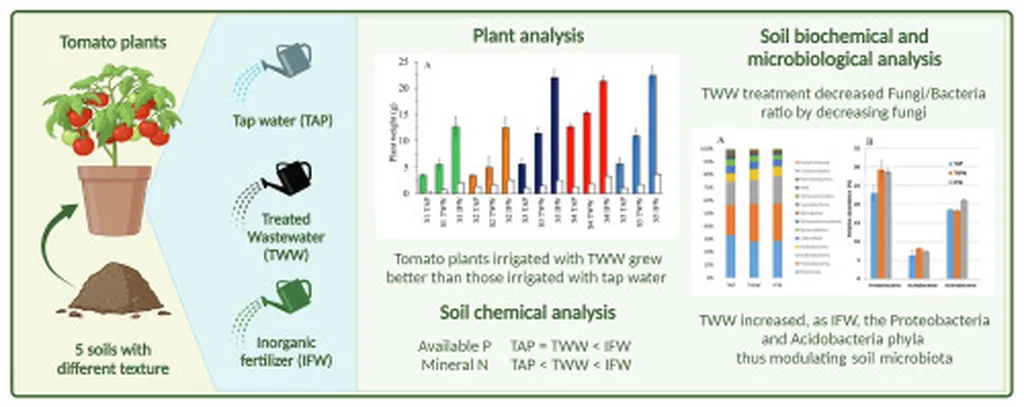
In the quest for sustainable agricultural practices, researchers are increasingly turning to treated wastewater as a viable irrigation solution. A recent study published in the *Turkish Journal of Agriculture: Food Science and Technology* sheds light on how this practice impacts tomato plants at a physiological and molecular level, offering promising insights for the agriculture sector.
The study, led by Merve Dilek Karataş from Van Yüzüncü Yıl University’s Faculty of Agriculture, investigated the effects of treated wastewater irrigation on chlorophyll content, leaf color, and gene expression in tomato plants (Solanum lycopersicum L.) during their early developmental stages. The findings suggest that treated wastewater irrigation can significantly enhance photosynthetic capacity in tomato plants while also activating stress-related pathways.
Karataş and her team compared two treatments: control (tap water) and treated wastewater irrigation. They assessed physiological parameters, including SPAD values and leaf color, and quantified the expression of growth and stress-related genes (SlDREB2, SlARF9, and SlEXP1) using RT-qPCR. The results were striking. Treated wastewater irrigation significantly increased chlorophyll content in tomato leaves, shifting their coloration toward darker, greenish hues. “This enhancement in chlorophyll content suggests that treated wastewater irrigation can boost photosynthetic efficiency in tomato plants,” Karataş explained.
At the molecular level, the study revealed a pronounced upregulation of the SlDREB2 gene, which is associated with abiotic stress responses. Conversely, the expression of SlEXP1, a gene linked to growth processes, was suppressed. While the SlARF9 gene showed an increase in expression relative to the control, this change was not statistically significant.
The commercial implications of these findings are substantial. As water scarcity becomes an increasingly pressing issue, the agricultural sector is in dire need of sustainable irrigation solutions. Treated wastewater, often overlooked or underutilized, presents a promising alternative. “Our results indicate that treated wastewater irrigation can enhance plant health and productivity, which could be a game-changer for farmers facing water shortages,” Karataş noted.
Moreover, the study’s insights into gene expression provide a deeper understanding of how plants respond to treated wastewater irrigation. This knowledge could pave the way for developing crops that are more resilient to stress conditions, further bolstering agricultural productivity.
The research also highlights the importance of monitoring and optimizing irrigation practices to maximize their benefits. As Karataş pointed out, “While treated wastewater irrigation shows great promise, it’s crucial to understand its long-term effects on plant health and soil quality. Further research in this area will be essential for developing sustainable agricultural practices.”
In conclusion, this study offers a compelling case for the use of treated wastewater in agriculture, with potential benefits for both plant health and commercial productivity. As the agricultural sector continues to grapple with water scarcity and climate change, innovative solutions like these will be vital for ensuring food security and sustainability. The findings published in the *Turkish Journal of Agriculture: Food Science and Technology* by lead author Merve Dilek Karataş from Van Yüzüncü Yıl University’s Faculty of Agriculture provide a significant step forward in this endeavor.