
In the quest to unlock the full potential of agricultural crops, scientists are increasingly turning to innovative technologies. A recent study published in *Scientific Reports* has revealed that reactive air plasma (ReAP) treatment can significantly enhance the extraction yield and bioactive properties of wheat lipids, opening new avenues for the agriculture and cosmetics industries.
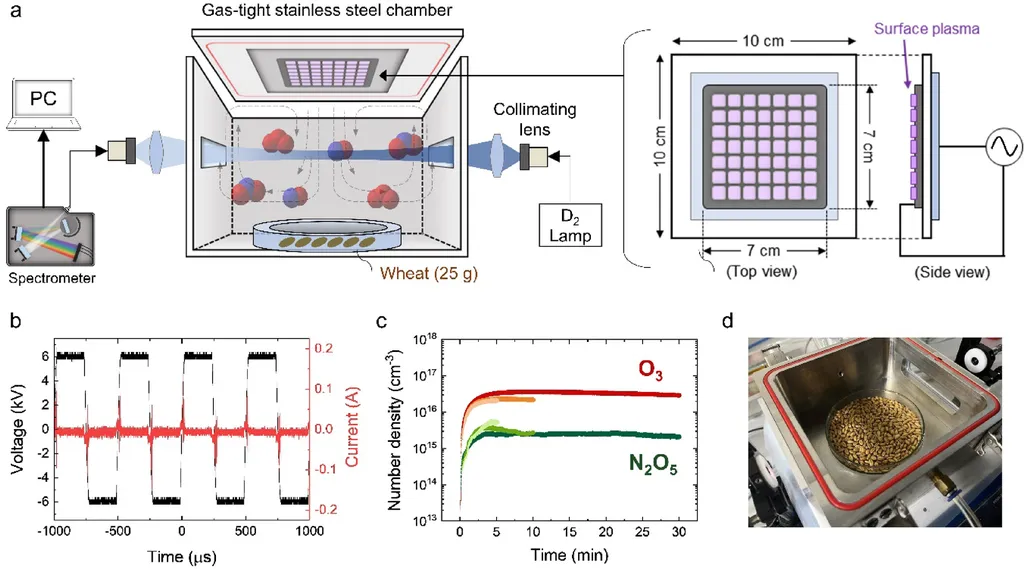
The research, led by Hyun-Joo Kim from the Department of Food Science at the National Institute of Crop and Food Science, Rural Development Administration, explored the effects of ReAP treatment on wheat lipids. By exposing wheat samples to a surface dielectric barrier discharge (sDBD) for varying durations, the team discovered that a 10-minute treatment yielded the highest lipid extraction rate, increasing from 1.78% in the control group to 2.97%.
This enhancement in lipid yield is not just a quantitative leap but also a qualitative one. The ReAP-treated wheat lipids demonstrated significantly improved bioactivity, particularly in terms of elastase and tyrosinase inhibitory activities. These enzymes are key players in skin aging, with elastase breaking down elastin and tyrosinase contributing to hyperpigmentation. The study found that the inhibitory activities increased from 24.62% to 61.79% for elastase and from 34.67% to 72.76% for tyrosinase, indicating a substantial boost in the anti-aging potential of the treated lipids.
Moreover, the moisturizing effect of the lipids was highest at a concentration of 200 µg/mL combined with 10 minutes of ReAP treatment. This trifecta of improved yield, enhanced bioactivity, and superior moisturizing properties positions wheat lipids as promising ingredients for the cosmetics industry.
The study also delved into the chemical composition of the lipids, revealing that palmitic and linoleic acid concentrations increased by 5.29-fold and 8.34-fold, respectively, compared to the untreated control. These fatty acids are known for their beneficial effects on skin health, further underscoring the potential of ReAP-treated wheat lipids in cosmetic formulations.
Microscopic analysis provided additional insights, showing that plasma treatment disrupted the wheat surface structure and reduced surface roughness. This structural alteration likely facilitates the extraction process, contributing to the increased yield observed in the study.
The commercial implications of this research are substantial. As the demand for natural and effective anti-aging ingredients continues to grow, the agriculture sector can capitalize on this technology to produce high-value wheat lipids. “This study highlights the potential of reactive air plasma treatment to enhance the value of agricultural crops,” said Hyun-Joo Kim. “By improving the extraction yield and bioactivity of wheat lipids, we can create new opportunities for farmers and the cosmetics industry alike.”
The findings also pave the way for further research and development. As Kim noted, “Further animal or clinical studies and verification using scaled-up plasma systems are warranted to fully realize the potential of this technology.” This next step could solidify the role of ReAP-treated wheat lipids in the cosmetics market and potentially lead to the development of other plasma-treated agricultural products.
In the broader context, this research exemplifies how advanced technologies can transform traditional agricultural practices. By harnessing the power of plasma treatment, the agriculture sector can unlock new value from familiar crops, creating a ripple effect that benefits farmers, manufacturers, and consumers. As the world continues to seek sustainable and effective solutions for skin care, the marriage of agritech and cosmetics offers a promising path forward.