
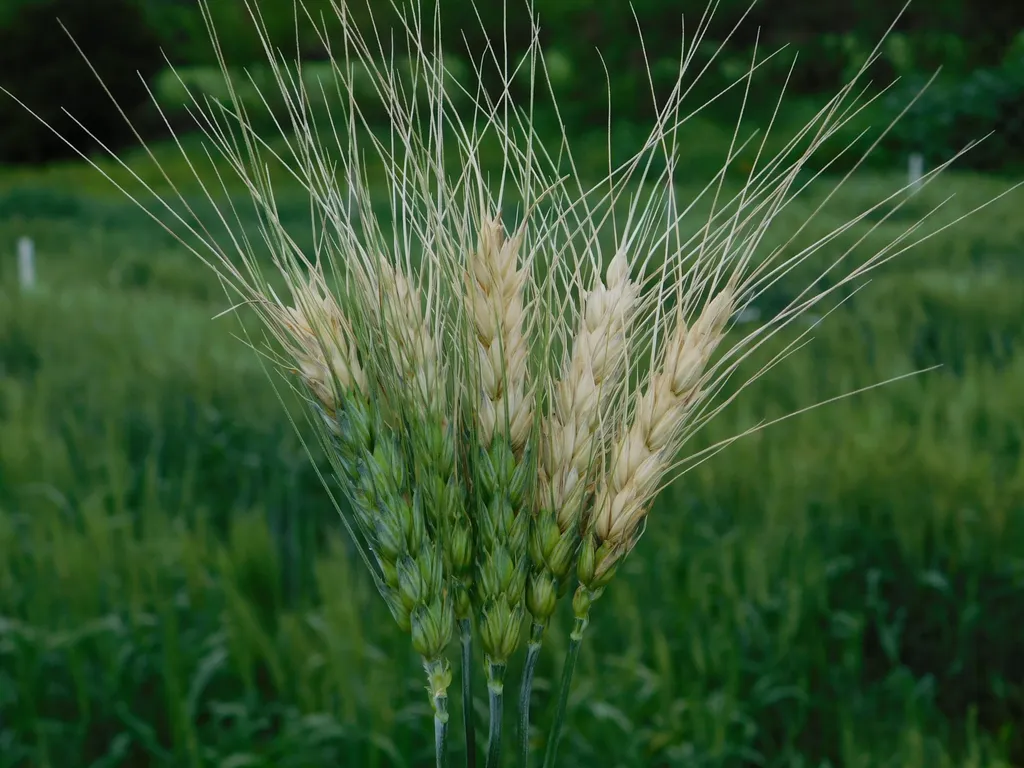
In the relentless battle against wheat blast disease, a formidable foe threatening global food security, scientists have made a significant stride in understanding the molecular dynamics at play. A recent study published in *Scientific Reports* has shed light on the intricate interactions between the wheat blast resistance gene Rmg8 and the AVR-Rmg8 effector proteins, offering promising avenues for enhancing wheat blast resistance in crops.
Wheat blast, caused by the Triticum pathotype of Magnaporthe oryzae (MoT), has been a persistent challenge for farmers, particularly in regions like Bangladesh and Zambia. The Rmg8 gene, isolated from a hexaploid wheat cultivar, has shown strong resistance to MoT isolates carrying the eI type of AVR-Rmg8. However, the molecular mechanisms underlying this resistance have remained elusive until now.
The study, led by Soharth Hasnat from the Institute of Biotechnology and Genetic Engineering (IBGE) at Gazipur Agricultural University (GAU), employed computational biology approaches to elucidate the structural and biological characteristics of RMG8 proteins and their recognition of AVR-Rmg8 effector proteins. The researchers found that only three amino acid residues distinguish the eI type of AVR-Rmg8, which induces a higher level of resistance conferred by RMG8.
One of the most intriguing findings was that only the eI type effector interacts with ATP through the Pro26 residue, a feature not present in the other AVR-Rmg8 types. “This interaction is crucial for the strong recognition of the eI type of AVR-Rmg8 by the RMG8 protein,” explained Hasnat. The study identified the Protein Kinase C (PKC) domain of RMG8, where proline dependency mediates the phosphorylation of a serine residue, as a key player in this recognition process.
Phylogenetic analyses suggested that RMG8 might have evolved from proteins closely associated with plant signaling pathways. Despite being an atypical resistance gene, the data indicate that RMG8 could function as a hub in the plant defense network. As a nuclear membrane protein, specifically a calcium-dependent multiple C2 domain protein with transmembrane regions (MCTP) kinase, RMG8 integrates signaling for effector recognition.
The implications of this research for the agriculture sector are substantial. Understanding the molecular recognition mechanism between AVR-Rmg8 and RMG8 can aid in the development of more effective wheat blast resistance breeding strategies. This could lead to the cultivation of wheat varieties that are more resilient to wheat blast, thereby enhancing food security and reducing economic losses for farmers.
“Our findings provide a detailed insight into the molecular recognition mechanism between AVR-Rmg8 and RMG8,” said Hasnat. “This knowledge is expected to aid in wheat blast resistance breeding, ultimately benefiting the agriculture sector and global food security.”
Future studies involving the purification and structural characterization of MoT effector proteins and Rmg8 gene products are necessary to validate these findings. Nonetheless, this research marks a significant step forward in the fight against wheat blast disease, offering hope for more sustainable and productive wheat farming in the future.