
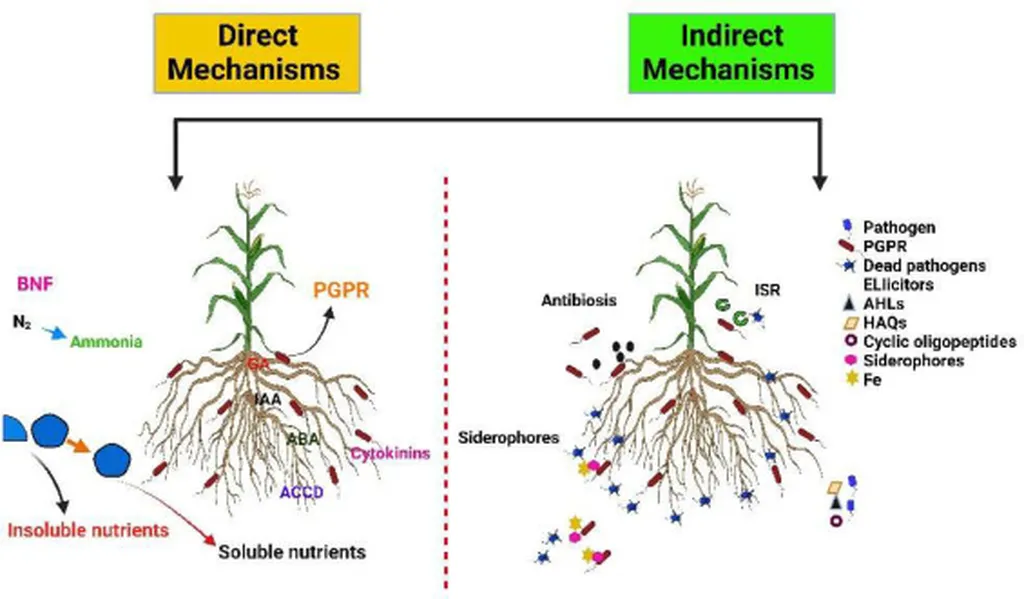
In the quest for sustainable agriculture, scientists are increasingly turning to the microscopic world for solutions. A recent study published in the *Journal of Sustainable Agriculture and Environment* has unveiled a promising approach that combines the benefits of plant growth-promoting rhizobacteria (PGPR) with the cutting-edge potential of nanotechnology. The research, led by Indu Bhardwaj from the Division of Microbiology at Career Point University in Hamirpur, Himachal Pradesh, India, focuses on the synergistic effects of Bacillus cereus Mn-5 PGPR-derived silver oxide nanoparticles (Ag₂O NPs) on tomato plant growth, stress resilience, and nutritional enhancement.
Agricultural crops are under siege from environmental stresses such as soil salinity and heavy metal contamination, exacerbated by climate change. These challenges threaten food security and necessitate innovative solutions. While PGPRs are known for their eco-friendly properties as agrochemical substitutes, their field efficacy has been inconsistent. The study investigates a multifunctional Bacillus cereus strain that acts as both a PGPR and a green synthesizer of silver oxide nanoparticles, offering a sustainable boost to early tomato seedling growth.
The research team isolated bacterial strains from the tomato rhizosphere and tested them for PGPR traits, biocontrol activities, and stress tolerance. The most effective isolate, identified as Bacillus cereus Mn-5, exhibited strong growth-promoting characteristics, including phosphate solubilization, siderophores production, nitrogen fixation, protease production, and antagonism against the pathogenic fungus Rosellinia necatrix. Notably, Mn-5 demonstrated remarkable tolerance to 8% salinity and heavy metals up to 100 µg/mL.
“Our findings suggest that Bacillus cereus Mn-5 PGPR-derived silver oxide nanoparticles can significantly enhance tomato seed germination and seedling growth,” said lead author Indu Bhardwaj. The study revealed that Mn-5 PGPR-derived Ag₂O NPs, when applied at a concentration of 5 ppm, promoted tomato seed germination, shoot-root growth, seed vigor index, and biomass by 200% over controls and 44.4% over PGPR alone. However, higher concentrations (50 and 100 ppm) were found to be phytotoxic, inhibiting seedling growth.
The characterization of the nanoparticles using XRD, SEM, TEM, and FTIR revealed spherical, agglomerated NPs with a crystallite size of 30.26 nm and a particle diameter of 80.16 ± 1.51 nm. The FTIR bands ranged from 400 to 4000 cm⁻¹, indicating the presence of various functional groups.
The commercial implications of this research are substantial. As the agriculture sector seeks sustainable and effective solutions to enhance crop yields and resilience, the integration of PGPR-derived nanoparticles offers a promising avenue. This approach not only reduces the reliance on chemical fertilizers and pesticides but also leverages the natural benefits of microbial interactions and nanotechnology.
“The potential of Bacillus cereus Mn-5 PGPR and biosynthesized Ag₂O NPs as eco-friendly bio-stimulants for tomato growth under stress is immense,” Bhardwaj added. The study establishes a baseline for future in vivo studies on dosage optimization, paving the way for sustainable agriculture practices.
As the world grapples with the challenges of climate change and food security, innovative research like this offers hope for a more resilient and productive agricultural future. The findings from this study could shape future developments in the field, encouraging further exploration of microbial biotechnology and nanotechnology in agriculture.