
In the ever-evolving landscape of agricultural technology, a new frontier is emerging—one that promises to revolutionize the way we manage one of the most pressing challenges in farming: soil salinity. A recent study published in ‘مجلة ديالى للعلوم الزراعية’ has shed light on the burgeoning field of nanotechnology for salinity stress management, offering a glimpse into the future of sustainable agriculture.
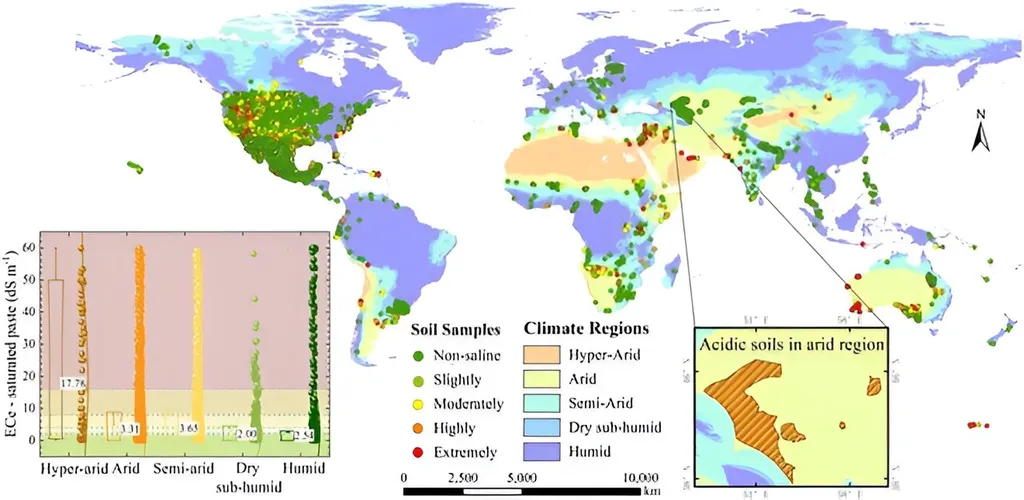
The research, led by Abhishek Singh from the Faculty of Biology at Yerevan State University, provides a comprehensive bibliometric analysis of peer-reviewed publications on nanotechnology and salinity stress from 2021 to 2024. The study, which analyzed 500 papers indexed in the Dimensions core database, reveals a significant expansion in research activity in this field. This surge in interest is not surprising, given the potential of nanotechnology to address the global issue of soil salinity, which affects an estimated 20% of irrigated lands worldwide.
Soil salinity is a critical issue for the agriculture sector, as it can lead to reduced crop yields and even complete crop failure. Traditional methods of managing salinity, such as leaching and soil amendments, have proven to be costly and often ineffective in the long term. Nanotechnology, however, offers a promising alternative. Nanoparticles can be engineered to enhance soil coverage, minimize salt accumulation, and improve the tolerance of crops to salinity stress.
“The use of nanotechnology in agriculture is not just a scientific curiosity; it is a practical solution to a real-world problem,” says Singh. “Our analysis shows that researchers are increasingly turning to nanotechnology to develop innovative strategies for managing soil salinity, and this trend is likely to continue in the coming years.”
The study highlights the significant contributions of the top 10 core source journals in this field, as well as the prominent role of researchers from countries such as China, India, Egypt, Pakistan, and Iran. This geographical distribution underscores the global nature of the issue and the collaborative efforts underway to address it.
From a commercial perspective, the implications of this research are substantial. The development of nanoparticle-based solutions for salinity stress management could lead to the creation of new products and technologies that can be marketed to farmers worldwide. This, in turn, could open up new revenue streams for agribusinesses and create jobs in the burgeoning field of agri-nanotechnology.
Moreover, the use of nanotechnology in agriculture could have a positive impact on food security, particularly in regions where soil salinity is a major constraint to crop production. By enhancing the productivity of saline soils, nanotechnology could help to increase food supplies and improve the livelihoods of millions of people.
Looking ahead, the findings of this study suggest that nanotechnology will play an increasingly important role in the management of soil salinity. As research in this field continues to expand, we can expect to see the development of new and innovative solutions that will help to address this critical challenge in agriculture.
In the words of Singh, “The future of agriculture lies in our ability to harness the power of nanotechnology to create sustainable and resilient farming systems. This research is a step in that direction, and I am excited to see what the future holds.”
As we stand on the cusp of a new era in agricultural technology, the work of researchers like Singh offers a beacon of hope for a future where the challenges of soil salinity are met with innovative solutions, paving the way for a more sustainable and productive agriculture sector.