
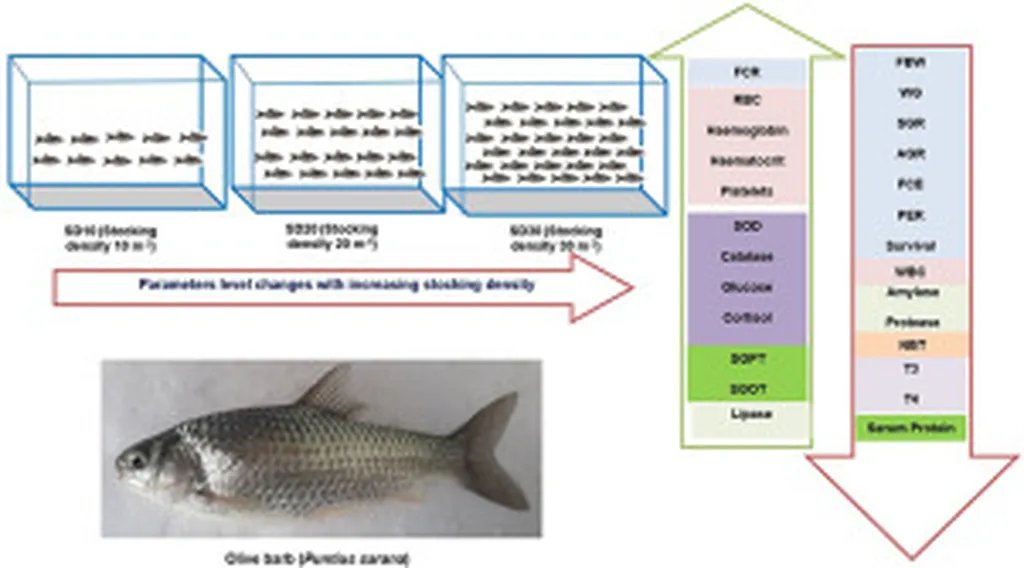
In the quest for sustainable aquaculture practices, a recent study published in *Frontiers in Sustainable Food Systems* has shed light on the optimal stocking densities for Amur carp (Cyprinus carpio haematopterus) in cage culture, offering valuable insights for farmers and policymakers alike. The research, led by Mitesh H. Ramteke from the ICAR-Central Inland Fisheries Research Institute in Kolkata, India, evaluated the impact of different stocking densities on growth performance, health, and economic efficiency of Amur carp reared in cages for 180 days.
The study explored three stocking densities: 10, 20, and 30 fish per cubic meter (m³). The findings revealed that while higher stocking densities resulted in greater biomass, the growth attributes such as final weight, weight gain, and specific growth rate significantly declined with increasing density. “Although SD 30 yielded more biomass, the physiological and biochemical analyses indicated that the fish were under considerable stress,” Ramteke explained. This stress was evident in increased levels of serum glutamate oxaloacetate transaminase (SGOT), serum glutamate pyruvate transaminase (SGPT), glucose, cortisol, and antioxidant enzymes, while serum proteins, lipids, thyroid hormones, and immune markers decreased.
The economic implications of these findings are substantial. The benefit–cost ratio was highest at the lowest stocking density, SD 10, at 1.38. This suggests that while higher densities might seem profitable at first glance, the long-term health and growth of the fish—and consequently, the economic returns—are compromised. “Our correlation analysis and Integrated Biomarker Response (IBR) indices confirmed that density-induced stress is a critical factor,” Ramteke noted. “The optimal stocking density for Amur carp in tropical Indian reservoir cage culture is 10 fish/m³.”
The study also highlighted the importance of maintaining optimal water quality, which remained within acceptable ranges throughout the experiment. This is a crucial factor for sustainable aquaculture, as it ensures the health and welfare of the fish while minimizing ecological impacts.
The research underscores the need for evidence-based management strategies that balance fish welfare, farmer profitability, and environmental sustainability. As the global demand for seafood continues to rise, these findings could shape future developments in aquaculture practices, promoting responsible farming and advancing sustainable food production in line with global Sustainable Development Goals (SDGs).
For the agriculture sector, this study offers a roadmap for optimizing stocking densities to enhance productivity and profitability while ensuring the health and welfare of the fish. By adopting these recommendations, farmers can contribute to more sustainable and responsible aquaculture practices, ultimately benefiting both the industry and the environment.