
In the vast, windswept fields of China’s Bashang Plateau, a technological revolution is brewing, one that promises to reshape the way we monitor and manage crop growth. A team of researchers, led by Pengpeng Zhang from the State Key Laboratory of Maize Bio-Breeding at China Agricultural University, has developed a novel deep learning framework that could significantly enhance the precision and scalability of agricultural monitoring.
The challenge at hand is a familiar one for modern agriculture: the need for real-time, accurate monitoring of crop growth to inform management decisions. While remote sensing technologies, such as unmanned aerial vehicles (UAVs) and satellites, offer multi-scale observational capabilities, conventional models have struggled with two key limitations. First, they often retrieve individual physiological traits independently, overlooking the dynamic coupling between structural and physiological traits. Second, they lack cross-platform model transferability, hindering the scaling of field-level precision to regional applications.
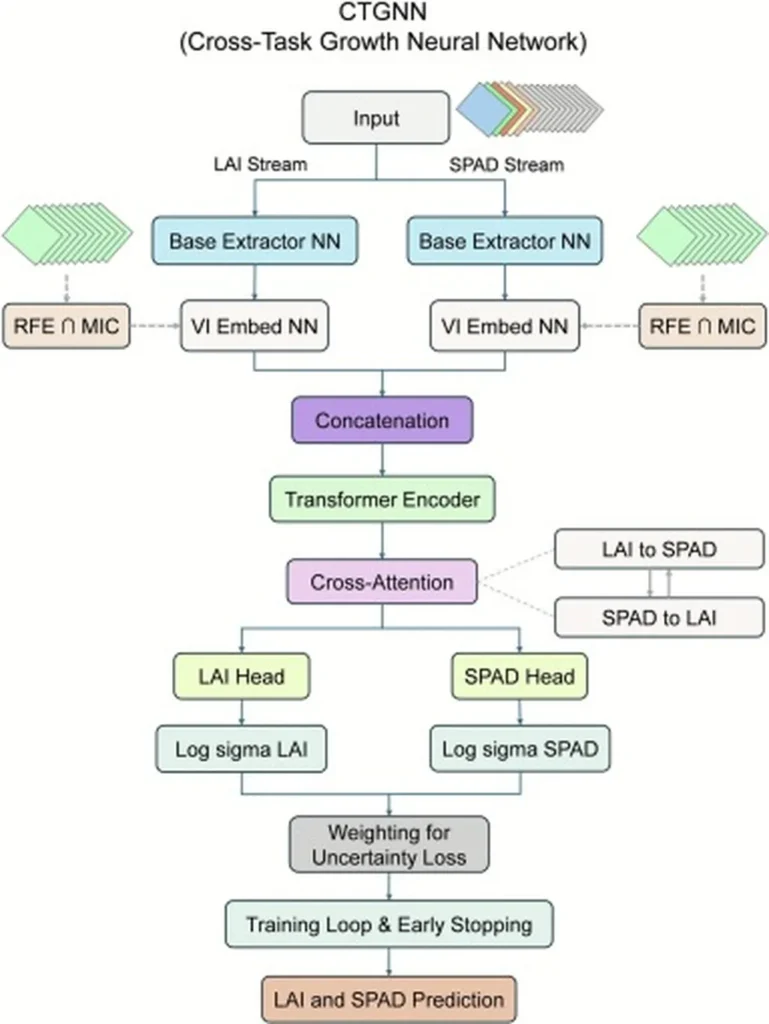
Enter the Cross-Task Growth Neural Network (CTGNN), a deep learning-based framework designed to address these very challenges. CTGNN employs a dual-stream architecture to process spectral features for Leaf Area Index (LAI) and Soil Plant Analysis Development (SPAD), using cross-trait attention mechanisms to capture their interactions. “This approach allows us to consider the interplay between different traits, providing a more holistic view of crop growth,” Zhang explains.
But the innovation doesn’t stop there. The researchers also assessed the knowledge transfer capabilities of the model, comparing two transfer learning strategies—Transfer Component Analysis (TCA) and Domain-Adversarial Neural Networks (DANN)—to facilitate the adaptation of UAV-derived data to satellite-scale monitoring. The results were impressive. Validation using UAV-satellite synergetic datasets from extensively field-tested oat cultivars demonstrated that CTGNN significantly reduced prediction errors for LAI and SPAD compared with independent trait models. Moreover, the CTGNN model with the DANN strategy required only 5% of satellite-labeled data for fine-tuning to achieve regional-scale monitoring.
The commercial implications of this research are substantial. By enabling more accurate and scalable monitoring of crop growth, CTGNN could facilitate optimal decision-making in oat variety breeding and cultivation technique dissemination. This is particularly relevant for arid and semi-arid regions, where water and resource management are critical. “This technology has the potential to revolutionize precision agriculture, making it more accessible and effective for farmers worldwide,” Zhang says.
The research, published in the journal Artificial Intelligence in Agriculture, represents a significant step forward in the integration of deep learning and remote sensing technologies in agriculture. As we look to the future, the potential for similar frameworks to be developed for other crops and regions is immense. This could usher in a new era of agricultural monitoring, one that is more precise, more scalable, and ultimately, more sustainable.
In the words of Zhang, “This is just the beginning. The possibilities are endless.” And with the commercial impacts of this research poised to reshape the agriculture sector, it’s an exciting time for both technologists and farmers alike.