
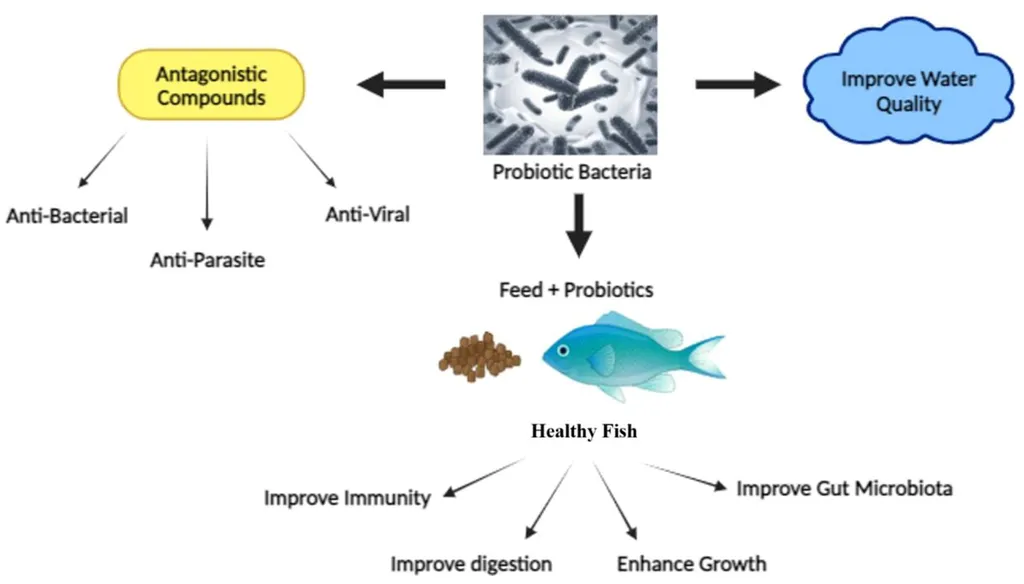
In the quest to bolster gut health and immunity in farmed fish, researchers have discovered a promising duo: chitooligosaccharides (COS) and Clostridium butyricum (CB). A study published in *Carbohydrate Polymer Technologies and Applications* reveals that combining these two compounds can significantly enhance intestinal barrier function, antioxidant capacity, and immunomodulation in largemouth bass, offering a sustainable strategy for aquaculture.
The research, led by Ge Bai of the National Key Laboratory of Agricultural Microbiology at Huazhong Agricultural University, systematically screened multiple polysaccharides to identify the most effective prebiotic for promoting the growth and intestinal adhesion of CB. Chitooligosaccharides emerged as the top performer, setting the stage for a deeper investigation into their combined effects with CB.
While the study did not observe significant differences in growth performance among the groups, the combined supplementation of COS and CB yielded remarkable improvements in other areas. “We saw a substantial reduction in hepatic stress markers, with ALT and AST levels dropping by 75.8% and 83.8%, respectively,” Bai explained. This suggests a potential alleviation of liver stress, a common issue in intensive aquaculture settings.
The intestinal antioxidant capacity of the fish also saw a significant boost, with glutathione peroxidase (GSH-Px) levels increasing by 282.4% and total antioxidant capacity (T-AOC) rising by 121.0%. Meanwhile, malondialdehyde (MDA) levels, an indicator of oxidative stress, decreased by 34.3%. These findings point to a strengthened antioxidant defense system, which could help fish better withstand the challenges of aquaculture environments.
The study also delved into the expression of tight junction proteins, which are crucial for maintaining the integrity of the intestinal barrier. RT-qPCR analysis revealed a profound upregulation of Claudin-1, Claudin-4, and ZO-1, indicating enhanced barrier integrity. This could potentially reduce the incidence of enteric diseases, a major concern in aquaculture.
Moreover, the combined supplementation exerted strong immunomodulatory effects. Hepatic cytokine profiling showed a suppression of pro-inflammatory cytokines IL-1β and IL-8 by 75.7% and 73.6%, respectively, while anti-inflammatory cytokine IL-10 was upregulated by 2.29-fold. The expression of TCR-α/β, markers of immune response, also saw a 3–4-fold increase. These results suggest that COS and CB together could help modulate the immune system, striking a balance between pro- and anti-inflammatory responses.
The gut microbiome also underwent restructuring, with a reduction in Pseudomonadota and an enrichment of beneficial Bacillota. This shift could contribute to improved gut health and overall fish well-being.
The implications of this research for the agriculture sector are substantial. As the demand for seafood continues to grow, so does the need for sustainable and efficient aquaculture practices. The findings suggest that COS and CB could be valuable tools in this endeavor, promoting gut health and immunity in farmed fish. This could lead to reduced disease incidence, improved growth performance, and ultimately, higher yields for aquaculture operations.
Furthermore, the study highlights the potential of prebiotics and probiotics in modulating gut health and immunity, not just in fish but potentially in other livestock as well. This could open up new avenues for research and development in the field of animal nutrition and health.
As the global aquaculture industry continues to evolve, the integration of such innovative strategies could pave the way for more sustainable and productive farming practices. The research led by Ge Bai at Huazhong Agricultural University offers a glimpse into the future of aquaculture, where the power of prebiotics and probiotics could be harnessed to promote gut health, immunity, and overall fish well-being.