
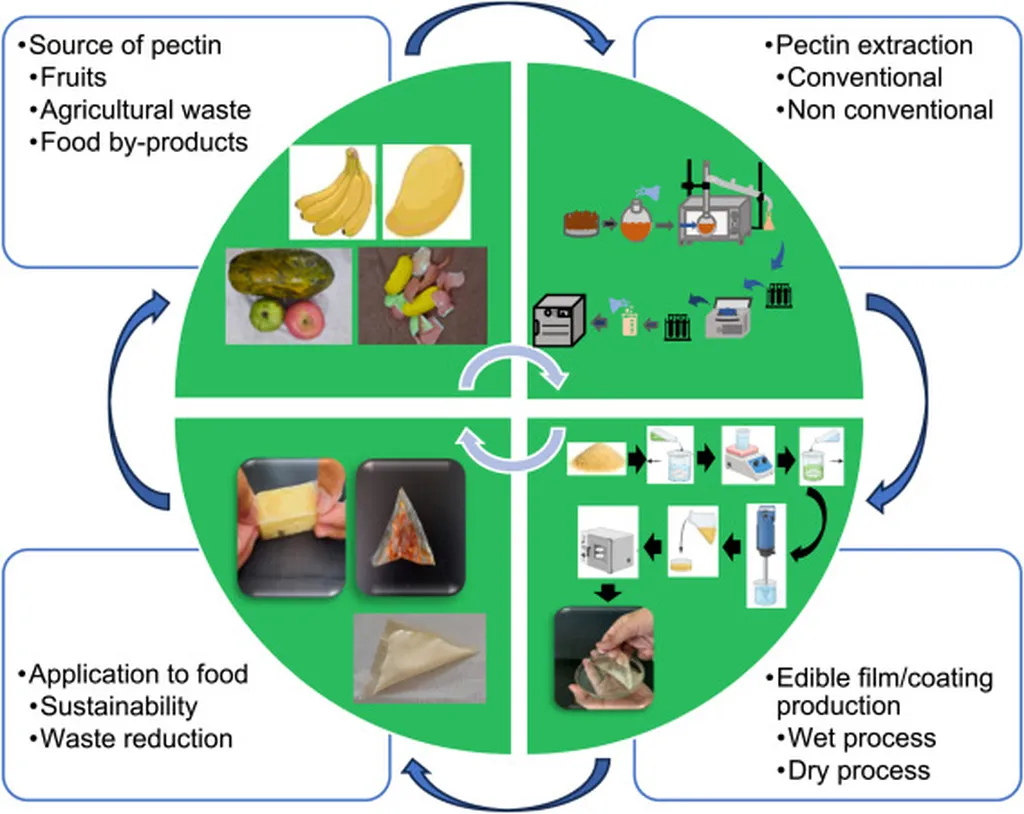
In the quest for sustainable food packaging solutions, researchers have turned to pectin, a naturally abundant polysaccharide, to create biodegradable films. However, pectin alone has its limitations, particularly in mechanical strength, water vapor barrier properties, and antimicrobial activity. A recent study published in *Applied Food Research* sheds light on how combining pectin with essential oils (EOs) can overcome these challenges, offering a promising avenue for active food packaging.
The study, led by Andi Fadiah Ainani from the Faculty of Agricultural Technology at Hasanuddin University in Indonesia, employs a bibliometric methodology to analyze research trends and significant findings in the domain of pectin-EO composite films. By examining 132 documents from Scopus, the research reveals that this field has seen substantial growth, particularly in India, with the highest number of publications recorded in 2024.
Pectin-EO composite films have demonstrated enhanced performance and stability through the optimal use of EO dosage, the selection of compatible matrices, and the application of innovative encapsulation methods. “The controlled release of essential oils in pectin films not only improves the antimicrobial and antioxidant properties but also extends the shelf life of various food products,” explains Ainani. This innovation holds significant potential for the agriculture sector, offering a sustainable and effective solution for food preservation.
The commercial impacts of this research are far-reaching. As consumer demand for eco-friendly packaging continues to rise, pectin-EO composite films provide a viable alternative to traditional plastic packaging. The enhanced shelf life of food products can reduce waste and lower costs for both producers and consumers. Moreover, the use of natural ingredients like pectin and essential oils aligns with the growing trend towards clean-label and sustainable products.
Looking ahead, this research could shape future developments in active packaging by encouraging further exploration of natural polymers and bioactive compounds. “The integration of essential oils into pectin films opens up new possibilities for creating high-value, biodegradable packaging solutions,” says Ainani. As the agriculture sector continues to innovate, the adoption of such sustainable technologies will be crucial in meeting the demands of a more environmentally conscious market.
In summary, the study highlights the potential of pectin-EO composite films to revolutionize food packaging, offering a sustainable and effective solution that benefits both the environment and the agriculture sector. With ongoing research and development, these innovative films could become a cornerstone of the future of food preservation.