
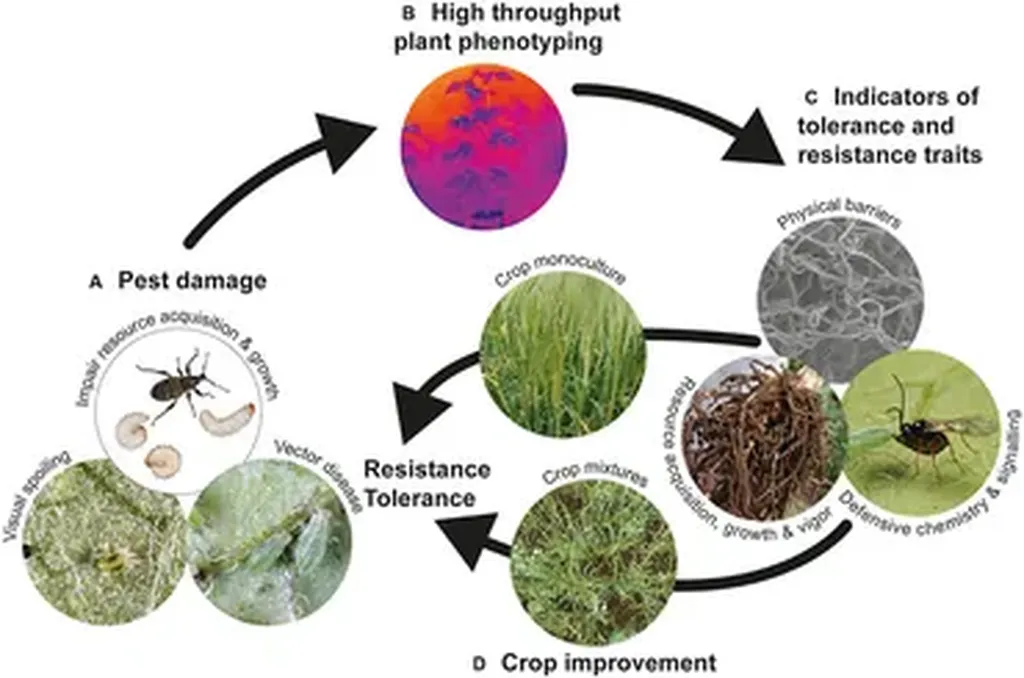
In a groundbreaking study published in *Industrial Crops and Products*, researchers have uncovered a novel approach to enhancing insect resistance in woody plants, offering promising implications for the agriculture sector. The study, led by Peipei Zhu from the Centre for Behavioral Ecology and Evolution (CBEE) at Hubei University and the College of Life Science at Wuchang University of Technology, explores the potential of endophytic entomopathogenic fungi to promote plant growth and prime defenses against herbivores.
The research focuses on *Beauveria bassiana*, a fungus known for its ability to directly infect pests. While its endophytic colonization in herbaceous plants has been studied, its role in woody plants remained largely unexplored until now. The team successfully demonstrated that *B. bassiana* can colonize *Salix matsudana* (willow) through foliar spray, with early and late-stage colonization confirmed at 7 and 21 days post-inoculation, respectively. Notably, late-stage colonized plants exhibited enhanced growth and stronger defense mechanisms, leading to a significant inhibition of leaf beetle survival and development.
“This study provides a deeper understanding of the molecular ecological mechanisms underlying fungus-induced insect resistance in woody plants,” said lead author Peipei Zhu. “Our findings establish a theoretical basis for plant-endophyte-herbivore interactions and offer a valuable reference for herbivore-mediated plant defense.”
The enhanced toxicity observed in late-stage colonized plants was attributed to the dual suppression of key immunity and detoxification gene expression in the beetles. Transcriptomic and metabolomic analyses revealed that *B. bassiana* colonization primed the plant’s defense by upregulating key genes and accumulating functional metabolites in the phenylpropanoid biosynthesis pathway. Key pathway genes remained highly expressed after herbivory, with associated metabolites like trans-cinnamic acid playing a crucial role in altering beetle feeding preferences and inhibiting larval development.
The commercial implications of this research are substantial. By leveraging endophytic fungi to enhance plant resistance, farmers could reduce their reliance on chemical pesticides, leading to more sustainable and environmentally friendly agricultural practices. “This approach could revolutionize pest management strategies, particularly in crops where insect resistance is a major challenge,” Zhu added.
The study not only sheds light on the intricate interactions between plants, endophytes, and herbivores but also paves the way for future developments in agricultural biotechnology. As researchers continue to explore the potential of endophytic fungi, the agriculture sector stands to benefit from more resilient crops and reduced environmental impact. This research, published in *Industrial Crops and Products* and led by Peipei Zhu, marks a significant step forward in the quest for sustainable pest management solutions.