
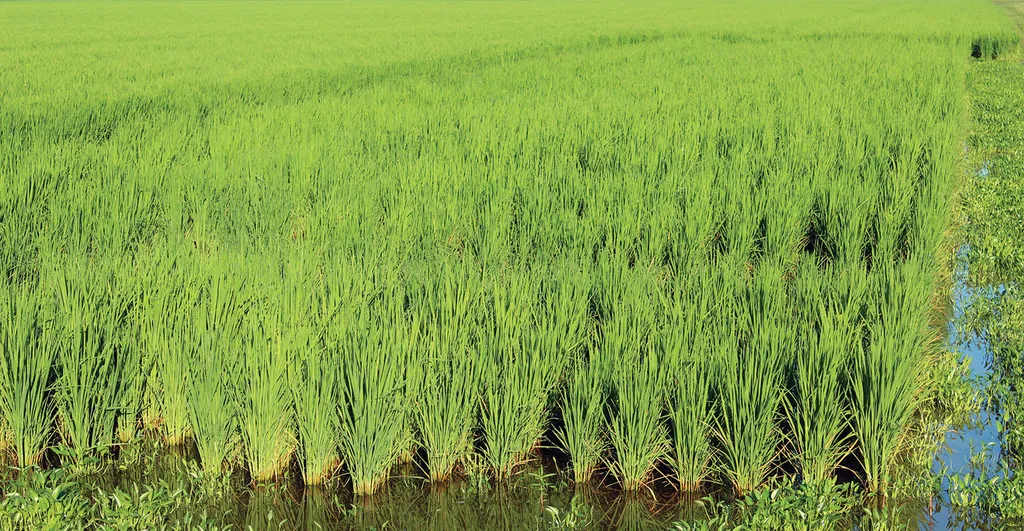
In the ever-evolving landscape of agricultural technology, a significant breakthrough has emerged that could revolutionize weed management in rice paddies. Researchers have successfully developed a glyphosate-tolerant genetically modified rice variety, BriA15-38, marking a pivotal step towards more efficient and sustainable weed control practices. This innovation, detailed in a study published in *GM Crops & Food*, opens new avenues for farmers grappling with the challenges of weed management in rice cultivation.
Glyphosate, a widely used broad-spectrum herbicide, has long been a staple in agricultural fields due to its efficacy, low toxicity, and minimal soil residue. However, its application in rice paddies has been limited because it inactivates both the rice plants and the weeds. To overcome this hurdle, scientists led by Jiangtao Yang from the Biotechnology Research Institute at the Chinese Academy of Agricultural Sciences set out to develop a glyphosate-tolerant rice variety.
The team constructed a vector containing the glyphosate-resistant gene aroAA1501 and introduced it into the rice variety ZH11 using Agrobacterium-mediated transformation. This process resulted in the generation of 37 transgenic plants, which were then evaluated for glyphosate tolerance through seed germination, hydroponic culture, and field spray tests. The results were promising, with the genetically modified rice plants exhibiting robust tolerance to glyphosate concentrations up to 8000 ppm.
“This breakthrough is a game-changer for rice farmers,” said Yang. “It allows for the effective use of glyphosate in paddy fields, which can significantly reduce the labor and costs associated with manual weeding.”
The study also confirmed the successful expression of the aroAA1501 gene and protein in the genetically modified plants. qRT-PCR analysis revealed significantly increased expression levels in the leaves following glyphosate application, while Western blot analysis confirmed the presence of the aroAA1501 protein. Additionally, shikimic acid content analysis demonstrated that the aroAA1501 protein effectively maintained normal metabolic activity, fulfilling the role of 5-enolpyruvylshikimate-3-phosphate synthase (EPSPS).
The implications of this research are far-reaching. By enabling the use of glyphosate in rice paddies, this innovation can enhance weed management practices, leading to increased crop yields and reduced environmental impact. The development of glyphosate-tolerant rice varieties also paves the way for the creation of other glyphosate-tolerant crops, further expanding the potential applications of this technology.
As the agricultural sector continues to seek sustainable and efficient solutions, this breakthrough offers a promising path forward. The study, led by Yang and his team, provides a valuable genetic resource for the development of glyphosate-tolerant genetically modified rice, offering a potential solution for efficient weed management in paddy fields. With further research and development, this innovation could shape the future of agriculture, making it more productive and environmentally friendly.
The research, published in *GM Crops & Food*, was led by Jiangtao Yang from the Biotechnology Research Institute at the Chinese Academy of Agricultural Sciences, Key Laboratory on Molecular Safety Assessment of Agri-GMO, MARA, Beijing, China. This study not only highlights the potential of genetic modification in agriculture but also underscores the importance of continued investment in agricultural research and development. As the world’s population grows, the need for innovative solutions to feed the planet becomes ever more pressing. This breakthrough in glyphosate-tolerant rice is a significant step towards meeting that challenge.