
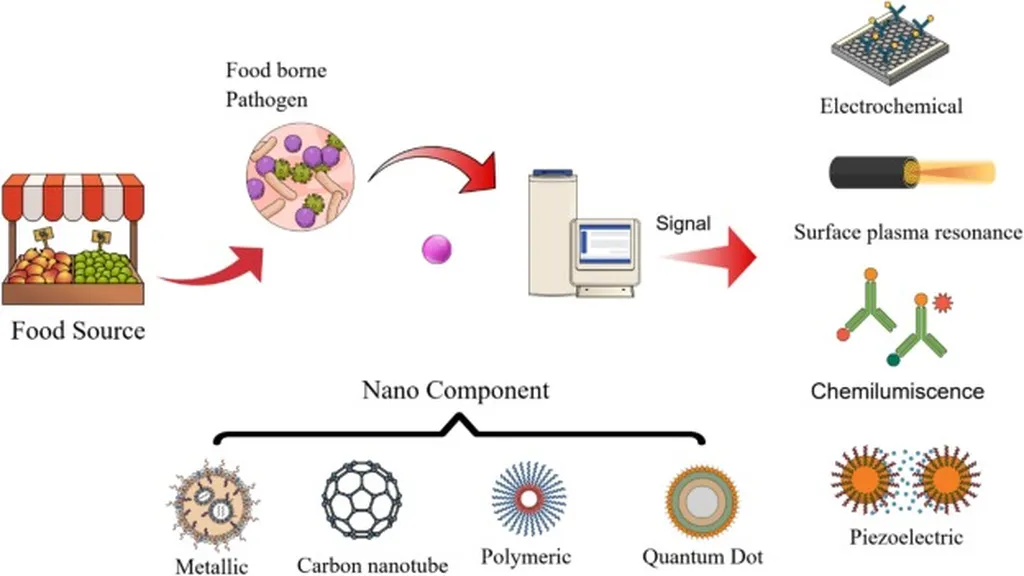
In the ever-evolving landscape of food safety, a groundbreaking development has emerged from the lab of Divagar Muthukumar at the Institute of Agricultural and Biosystems Engineering, ARO, Volcani Institute, Rishon LeZion, Israel. Researchers have unveiled a novel biosensing platform that promises to revolutionize the detection of pathogenic bacteria in food systems. Published in *Sensors and Actuators Reports*, this innovative approach leverages gold-nanoparticles coupled with porous silicon microarrays to create a highly sensitive and selective Surface-Enhanced Raman Scattering (SERS) transducer.
The new method employs antibody-functionalized gold nanoparticles (AuNPs) linked with a Raman reporter, which are then amplified by a silver-coated porous silicon microarray. This sophisticated setup enables the detection of multiple bacterial targets simultaneously, a significant advancement over traditional methods that often require separate tests for each pathogen. “The beauty of this system lies in its ability to detect multiple pathogens in a single assay, making it both time-efficient and cost-effective,” Muthukumar explains.
The platform’s sensitivity is nothing short of impressive, with detection limits as low as 4 CFU/mL for Bacillus cereus, 5 CFU/mL for Escherichia coli, and 5 CFU/mL for Staphylococcus aureus. These limits span a linear range of 101 to 105 CFU/mL, ensuring accurate quantification across a wide spectrum of bacterial concentrations. The selectivity of the bioassay was rigorously validated against common interfering enteropathogenic species, demonstrating minimal cross-reactivity.
One of the most compelling aspects of this research is its real-world applicability. The team tested various food samples, including irrigation water, lettuce, rice, chicken, and milk, achieving recovery rates between 81.4% and 107.1% with a relative standard deviation (RSD) below 8.5%. These results underscore the platform’s robustness and reliability in complex food matrices.
The commercial implications for the agriculture sector are profound. Rapid and accurate detection of foodborne pathogens is crucial for ensuring food safety and preventing outbreaks. This new technology could significantly reduce the time and resources required for pathogen detection, allowing for quicker response times and minimizing the risk of contaminated food reaching consumers. “This platform has the potential to transform the way we monitor food safety, providing a faster, more accurate, and cost-effective solution,” Muthukumar adds.
Looking ahead, this research opens up exciting possibilities for future developments in the field. The ability to detect multiple pathogens simultaneously could pave the way for more comprehensive and integrated food safety monitoring systems. Additionally, the use of portable Raman devices suggests that this technology could be deployed in various settings, from food processing plants to field inspections, further enhancing its practicality and impact.
In conclusion, the work published in *Sensors and Actuators Reports* by Divagar Muthukumar and his team represents a significant leap forward in the realm of food safety. By combining cutting-edge nanotechnology with advanced sensing techniques, they have created a platform that promises to revolutionize the detection of foodborne pathogens. As the agriculture sector continues to evolve, this innovative approach could play a pivotal role in ensuring the safety and quality of our food supply.