
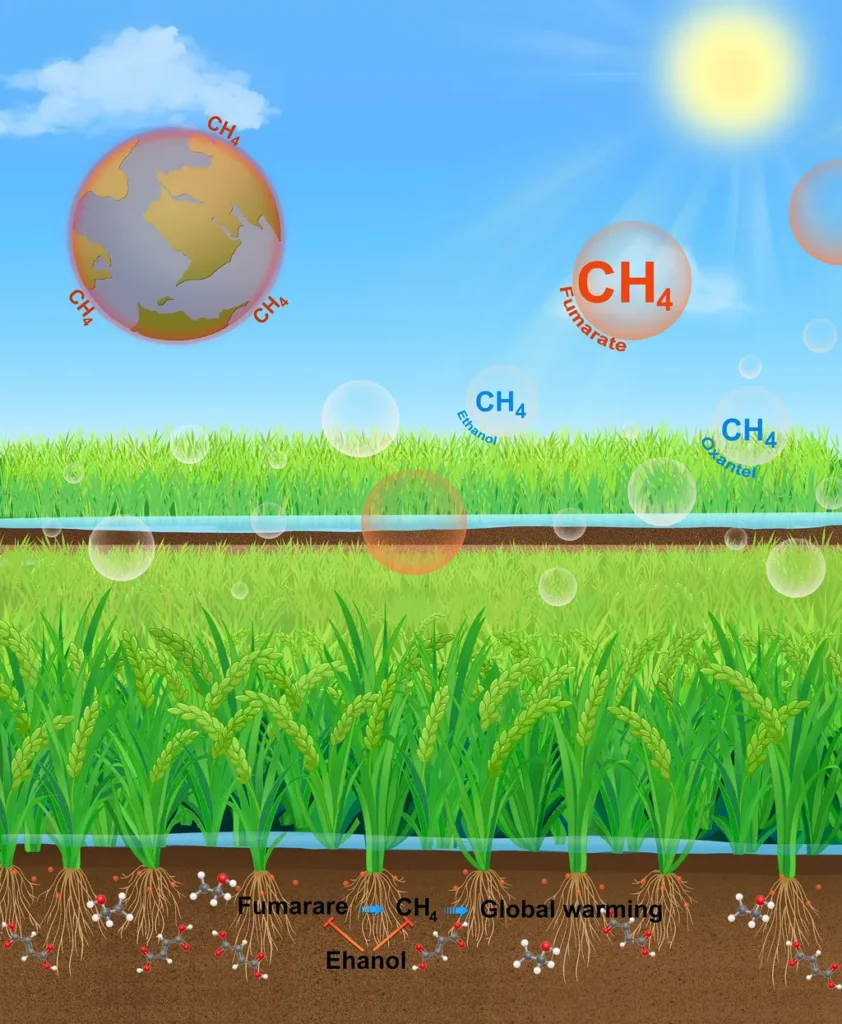
In the quest to balance environmental sustainability and food security, researchers have made a significant breakthrough in rice cultivation. A study published in *Agricultural Water Management* reveals that optimizing water management in paddy fields can simultaneously reduce methane emissions and cadmium accumulation in rice grains. This discovery offers a promising solution to a longstanding challenge in agriculture, where efforts to mitigate one issue often exacerbate the other.
The research, led by Zhiwei Tang from the Institute of Crop Sciences at the Chinese Academy of Agricultural Sciences, explored various irrigation regimes over three consecutive planting seasons. The team developed an innovative strategy called CTFG, which combines controlled irrigation (CI) during the rice tillering stage with continuous flooding (CF) during the grain-filling stage. This approach demonstrated remarkable efficacy in reducing both methane emissions and cadmium levels without compromising rice yield.
“Our findings show that the CTFG treatment achieved a 33% reduction in methane emissions and a 42% decrease in cadmium content in brown rice compared to high-yielding irrigation practices,” Tang explained. “This is a significant step forward in developing sustainable rice production systems.”
The study also revealed that the tillering and grain-filling stages play pivotal roles in regulating methane emissions and cadmium content, respectively. By implementing controlled irrigation during the tillering stage, the researchers effectively suppressed methanogen activity while enhancing methanotroph populations, thereby reducing methane emissions. Conversely, continuous flooding during the grain-filling stage decreased soil redox potential and promoted sulfate-reducing bacteria, limiting cadmium mobility and its uptake by rice plants.
The commercial implications of this research are substantial. Rice is a staple food for more than half of the world’s population, and the global rice market is valued at over $250 billion. The CTFG approach offers a practical and scalable solution for farmers to reduce their environmental footprint while maintaining productivity. This can enhance the marketability of rice, particularly in regions where food safety and environmental sustainability are increasingly prioritized by consumers.
Moreover, the study’s findings could influence policy and regulatory frameworks. Governments and international organizations may adopt these water management strategies as part of broader initiatives to mitigate greenhouse gas emissions and address heavy metal contamination in food crops. This could lead to incentives for farmers to implement these practices, further driving adoption and impact.
The research also highlights the importance of interdisciplinary collaboration. By integrating agronomy, microbiology, and environmental science, the study provides a holistic approach to addressing complex agricultural challenges. This could inspire similar collaborative efforts in other areas of crop production, leading to more sustainable and resilient food systems.
As the agriculture sector continues to grapple with the dual challenges of climate change and food security, the CTFG approach offers a beacon of hope. By optimizing water management, farmers can not only enhance the quality and safety of their crops but also contribute to global efforts to reduce greenhouse gas emissions. This research underscores the potential of innovative water management strategies to shape the future of sustainable agriculture.
The lead author, Zhiwei Tang, is affiliated with the Institute of Crop Sciences, Chinese Academy of Agricultural Sciences, Beijing, and the College of Agronomy and Biotechnology, China Agricultural University. The study was published in *Agricultural Water Management*, providing a valuable resource for researchers, policymakers, and practitioners in the field of sustainable agriculture.