
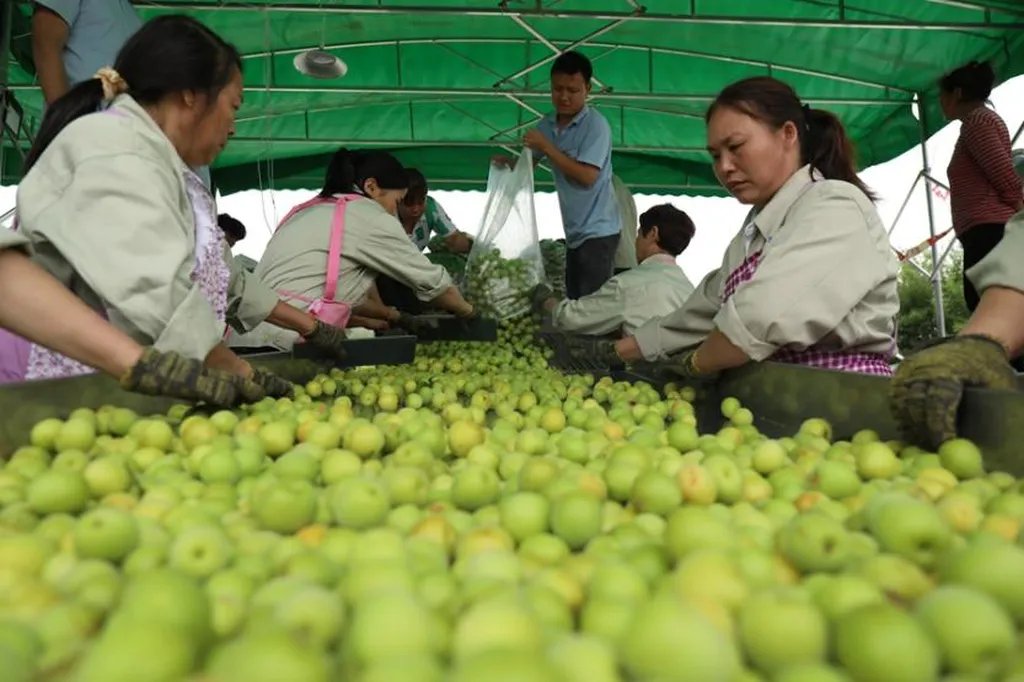
In the heart of China’s agricultural innovation, a groundbreaking study has unveiled how protected cultivation can significantly enhance the quality of Chinese plum (*Prunus salicina* L.), offering promising insights for the global agriculture sector. The research, led by Liangliang Cao from the Jiaxing Academy of Agricultural Science, was recently published in the journal *Plants*.
The study focused on the ‘Zuili’ variety of Chinese plum, a cultivar renowned for its high polyphenol levels and distinctive flavor. By comparing three cultivation systems—multi-span greenhouse (M), retractable electric rain shelter (R), and conventional open field (CK)—the researchers aimed to understand the molecular mechanisms behind quality variation under protected cultivation.
The findings were striking. The multi-span greenhouse treatment (M) increased fruit sweetness by 28.10% compared to the conventional open field (CK), without any yield loss. This significant improvement in fruit quality was attributed to the controlled light environments, which influenced sugar accumulation and secondary metabolism in the plum fruit.
“Our study reveals that protected cultivation, particularly using multi-span greenhouses, can enhance the sweetness and overall quality of Chinese plums without compromising yield,” said Liangliang Cao, the lead author of the study. “This is a game-changer for the agriculture sector, as it provides a molecular framework for optimizing cultivation strategies to improve both the sensory and nutritional attributes of fruit.”
The integrated transcriptomic and metabolomic analyses identified 7561 and 7962 upregulated genes in the M and R treatments compared to CK, respectively. These genes were significantly enriched in pathways related to sucrose metabolism, light-response, and ethylene-mediated signaling. The study also identified 1373 metabolites, with shading treatments increasing the abundance of several sugar-conjugated compounds.
The commercial implications of this research are substantial. By adopting protected cultivation practices, farmers can enhance the quality of their produce, making it more appealing to consumers and potentially fetching higher market prices. This could lead to increased profitability and sustainability in the agriculture sector.
Moreover, the study’s findings could pave the way for future developments in the field. As Liangliang Cao noted, “Our research provides a foundation for further exploration of how light regulation can be used to optimize fruit quality in other crops. This could revolutionize the way we approach agriculture, leading to more efficient and sustainable farming practices.”
In conclusion, this research highlights the potential of protected cultivation to improve fruit quality and offers a molecular framework for optimizing cultivation strategies. As the agriculture sector continues to evolve, such innovations will be crucial in meeting the growing demand for high-quality, nutritious produce.