
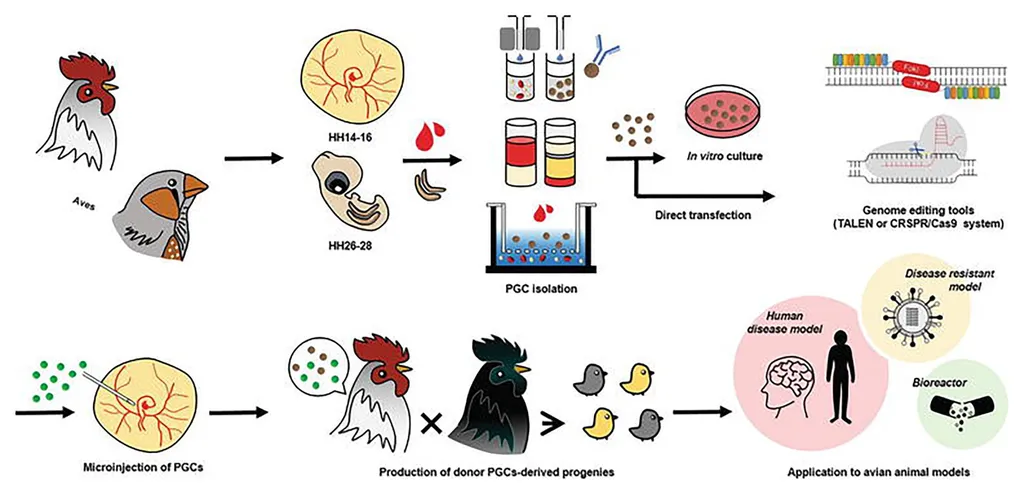
In a significant stride for the agricultural sector, researchers have harnessed the power of CRISPR/Cas9 technology to revolutionize poultry breeding and genetics. A recent study published in *Frontiers in Genome Editing* explores the transformative potential of this genome-editing tool in chickens, offering a glimpse into a future where precision breeding could redefine commercial poultry production.
CRISPR/Cas9, a third-generation genome-editing tool, has emerged as a game-changer in the field of avian biotechnology. Unlike its predecessors, such as zinc finger nucleases and TALENs, CRISPR/Cas9 offers a more efficient and targeted approach to gene editing. The technology utilizes guided RNA (gRNA) and the Cas9 endonuclease to induce precise double-strand breaks in DNA, which are then repaired by the cell’s natural mechanisms. This process can disrupt gene function or introduce specific genetic modifications, paving the way for enhanced productivity and disease resistance in poultry.
The study, led by Gautham Kolluri from the Molecular Physiology Laboratory at the ICAR-Central Avian Research Institute in India, highlights the diverse applications of CRISPR/Cas9 in poultry. One of the most promising areas is the enhancement of disease resistance. “CRISPR/Cas9 allows us to target specific genes that confer resistance to avian influenza and Marek’s disease, which are significant threats to the poultry industry,” Kolluri explains. By introducing these genetic modifications, farmers could potentially reduce the need for vaccines and antibiotics, leading to more sustainable and cost-effective production.
Beyond disease resistance, CRISPR/Cas9 can also improve productivity traits such as growth rate, feed efficiency, and egg-laying capacity. “We can now introduce specific genetic changes that enhance these traits, accelerating the breeding process and reducing the time required to develop elite genetic lines,” Kolluri adds. This could have a profound impact on the commercial poultry sector, where efficiency and productivity are paramount.
Another innovative application of CRISPR/Cas9 is in-ovo sexing. This technique allows for the early determination of a chick’s sex while still in the egg, addressing ethical concerns surrounding the culling of male chicks in the egg-laying industry. By enabling the selective breeding of female chicks, this technology could lead to more humane and sustainable practices in poultry farming.
The study also explores the potential of CRISPR/Cas9 in bio-pharming, where chickens are used to produce therapeutic proteins or vaccines in their eggs. This approach could revolutionize the production of biopharmaceuticals, making it more efficient and cost-effective.
The regulatory implications of CRISPR/Cas9 technology are also discussed in the study. Since CRISPR/Cas9 does not integrate exogenous DNA into the genome, it is generally considered less contentious than traditional transgenic methods. This could facilitate the adoption of genome-edited poultry in commercial production environments, provided that regulatory frameworks are in place to ensure safety and ethical considerations.
The research underscores the transformative potential of CRISPR/Cas9 in the agricultural sector, offering a glimpse into a future where precision breeding could redefine commercial poultry production. As the technology continues to evolve, it is likely to play an increasingly important role in addressing the challenges faced by the poultry industry, from disease resistance to productivity and sustainability. With ongoing advancements, CRISPR/Cas9 could pave the way for a new agricultural revolution, benefiting farmers, consumers, and the environment alike.