
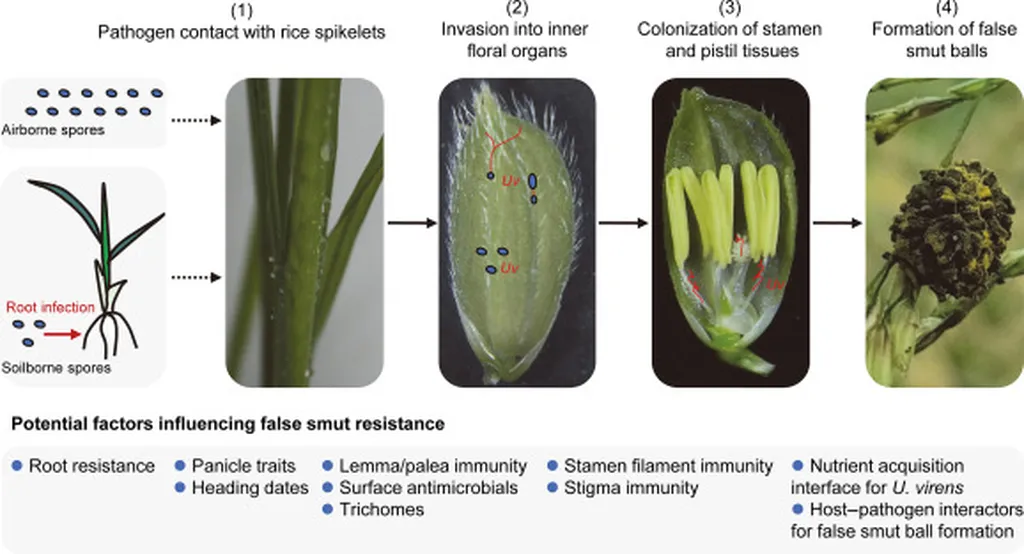
In the heart of India’s rice-growing regions, a critical battle is being waged against a stealthy foe: false smut, a disease caused by the fungus Ustilaginoidea virens. This insidious pathogen not only mars the aesthetic appeal of rice grains but also poses a significant threat to crop yields and quality. Recent research published in the *International Journal of Bio-Resource and Stress Management* offers a glimmer of hope, identifying rice genotypes that could hold the key to combating this pervasive disease.
The study, led by Somshetty Ravali from the Department of Plant Pathology at Professor Jayashankar Telangana State Agricultural University, screened 60 rice germplasm lines over two growing seasons. The findings are promising, with 16 genotypes exhibiting a highly resistant reaction to false smut. “This is a significant breakthrough,” Ravali remarked, “as it provides a foundation for developing resistant rice varieties that can withstand the pressures of false smut infection.”
The research revealed that compact panicles were more susceptible to the disease, while panicle length showed a significant negative correlation with false smut incidence. This insight could guide breeders in selecting traits that enhance resistance. Moreover, the study found that grain type played a crucial role, with short slender grains being the most susceptible and extra-long slender grains the least affected.
The commercial implications of this research are substantial. False smut not only reduces yield but also diminishes the market value of infected grains. By identifying resistant genotypes, farmers can potentially increase their yields and improve the quality of their harvests, leading to better market prospects. “This research is a stepping stone towards more resilient rice varieties,” Ravali added, “which is crucial for food security and economic stability in rice-growing regions.”
The study also highlighted the importance of morphological traits in disease resistance, suggesting that future breeding programs should consider these traits alongside genetic markers. This holistic approach could accelerate the development of high-yielding, disease-resistant rice varieties.
As the agricultural sector faces increasing pressures from climate change and pathogen evolution, the need for resilient crop varieties has never been greater. This research not only provides immediate solutions but also paves the way for future innovations in rice breeding. By understanding the intricate relationship between plant morphology and disease resistance, scientists can develop strategies that are both effective and sustainable.
In the quest for food security and economic stability, every breakthrough counts. This study, with its focus on false smut resistance, is a testament to the power of scientific inquiry in addressing real-world agricultural challenges. As Ravali and her team continue their work, the future of rice farming looks a little brighter, one resistant genotype at a time.