
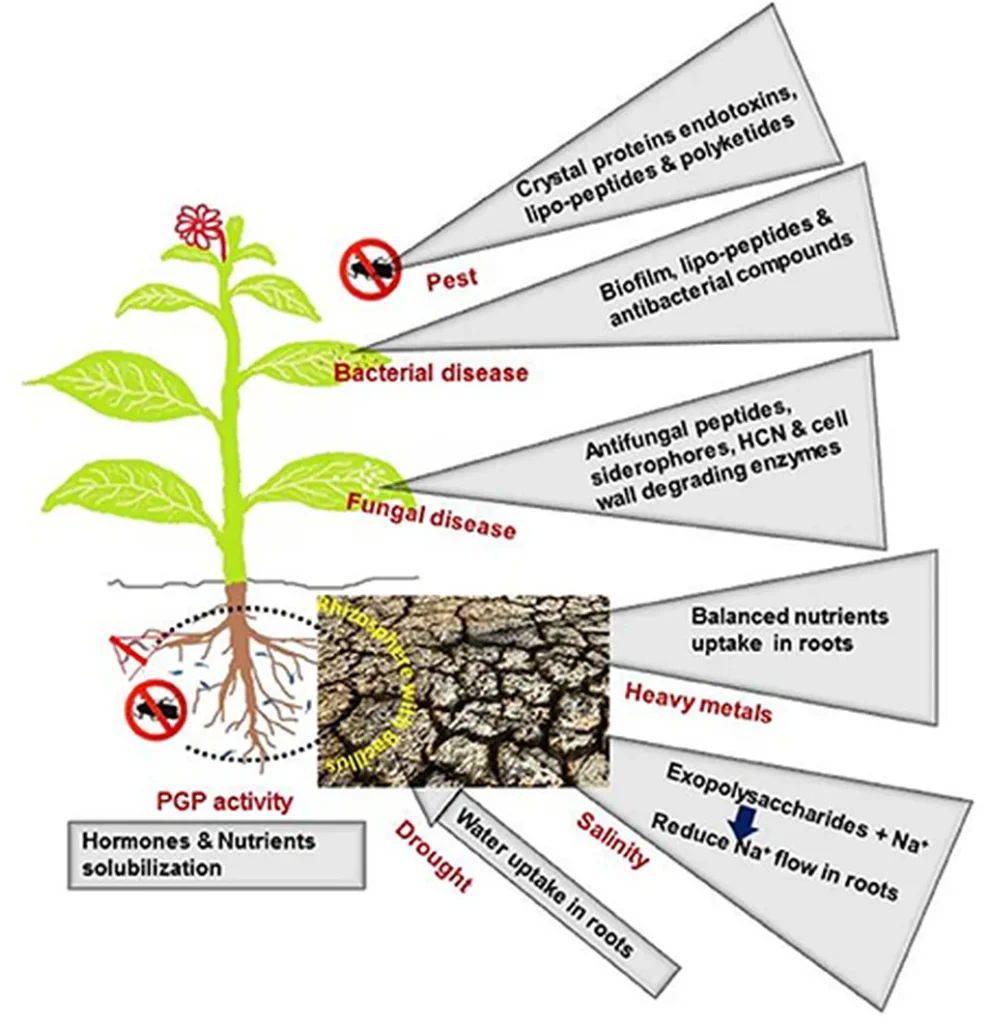
In the ongoing battle against plant diseases, scientists are turning to nature’s own arsenal for sustainable solutions. A recent study published in *Biological Control* has uncovered promising results in the use of endophytic Bacillus bacteria as biocontrol agents and plant growth promoters, offering a beacon of hope for the agriculture sector.
The research, led by Zerui Feng from Guizhou University, isolated 326 bacterial strains from 20 different hosts and identified four strains of Bacillus spp. with high antagonistic activity against Fusarium oxysporum, a notorious plant pathogen. Among these, Bacillus subtilis A2M2177 and B. subtilis A2M2295 stood out for their ability to produce indole-3-acetic acid (IAA), solubilize phosphate, and produce enzymes like protease, amylase, and cellulase. Notably, these two strains also exhibited siderophore production, a key trait for suppressing plant pathogens.
The implications for agriculture are substantial. In greenhouse experiments, Nicotiana tabacum L. seedlings inoculated with these Bacillus strains showed significantly improved growth parameters, including plant height, leaf area, stem width, fresh weight, dry weight, and chlorophyll content. Moreover, the strains significantly reduced the occurrence and severity of tobacco root rot, a soil-borne disease that can devastate crops.
“These findings suggest that Bacillus subtilis A2M2177 and B. subtilis A2M2295 have high potential as biocontrol agents and plant growth promoters,” said lead author Zerui Feng. “Their ability to enhance plant growth and suppress disease could revolutionize disease management practices in agriculture.”
The commercial impact of this research could be profound. As the global push for sustainable and eco-friendly agricultural practices grows, the demand for effective biocontrol agents is on the rise. These Bacillus strains could offer a cost-effective and environmentally friendly alternative to chemical pesticides, reducing the environmental footprint of agriculture while boosting crop yields.
The study’s findings align with a broader trend in agritech towards integrating biological solutions into crop management strategies. As Zerui Feng noted, “The use of endophytic bacteria like Bacillus spp. represents a paradigm shift in how we approach plant disease management. It’s not just about eradicating pathogens; it’s about fostering a symbiotic relationship between plants and beneficial microbes.”
Looking ahead, this research could pave the way for the development of new biocontrol products tailored to specific crops and pathogens. The agriculture sector stands to benefit greatly from these advancements, as they could lead to more resilient crops, reduced chemical inputs, and improved environmental sustainability.
As the world grapples with the challenges of feeding a growing population while minimizing environmental impact, innovations like these offer a glimmer of hope. The integration of endophytic bacteria into agricultural practices could very well be a game-changer, heralding a new era of sustainable and productive farming.