
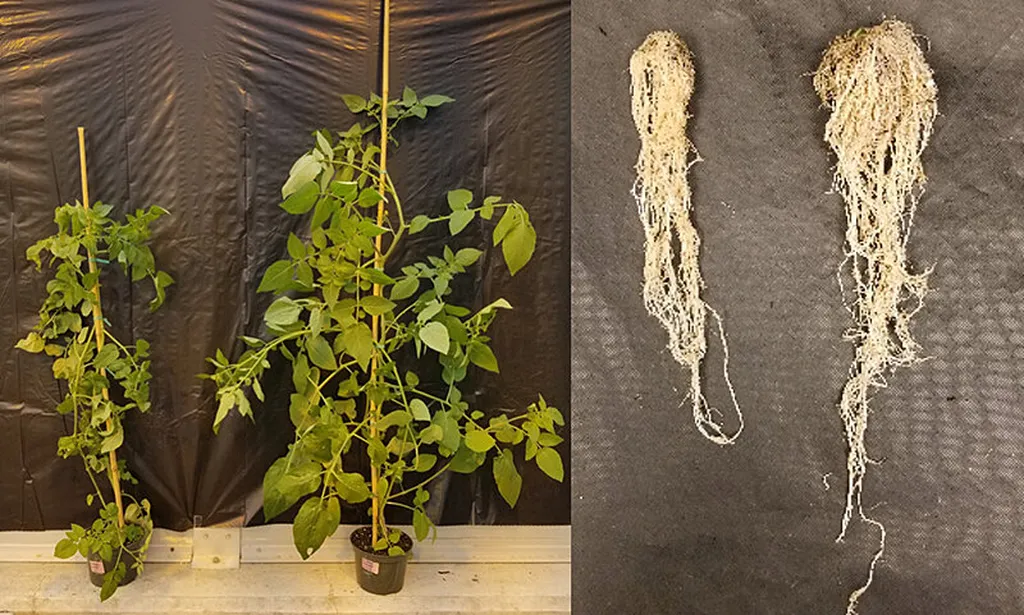
In the heart of agricultural innovation, a recent study published in the journal ‘Plants’ has shed light on the intricate relationship between tomato domestication and the root microbiome, offering promising avenues for crop improvement. Led by Grigorios Thomaidis from the Laboratory of Plant Pathology at Democritus University of Thrace, the research delves into the microbial communities associated with the roots of cultivated tomatoes and their wild relatives, revealing insights that could reshape future breeding strategies.
The study compared the rhizosphere and endosphere bacterial communities of the cultivated tomato variety Moneymaker with six wild relatives, spanning the main wild lineages within the Solanum sect. Lycopersicon. Using multi-region 16S rRNA sequencing, the researchers uncovered a fascinating interplay between phylogenetic divergence and domestication in shaping the tomato root microbiome.
“Domestication has long been known to reduce genetic diversity in crops, often leading to decreased resilience,” Thomaidis explained. “Our study suggests that domestication also altered the structure and function of root-associated microbiomes, creating new opportunities to harness beneficial microbes for breeding and crop improvement.”
The findings revealed that while the overall bacterial community structure in the rhizosphere was broadly conserved across all seven hosts, subtle yet significant differences emerged. The microbiomes were ordered along a gradient consistent with host phylogeny, with the cultivated tomato Moneymaker clustering near its wild relative S. pimpinellifolium. The four green-fruited Eriopersicon species formed a cohesive block, while S. pennellii occupied the most distinct position.
These differences highlight specific recruitment preferences among individual hosts. For instance, Streptomycetaceae were enriched in S. pimpinellifolium, Bacillaceae in S. chilense, and contrasting patterns of nitrifiers were observed among Eriopersicon species and S. pennellii. In the endosphere, differential abundance testing revealed consistent reductions in several bacterial families in wild accessions, alongside the enrichment of Streptomycetaceae and Rhodobiaceae in multiple wild species.
The commercial implications of this research are substantial. By understanding the microbial associations of wild relatives, breeders can potentially introduce beneficial microbes into cultivated tomatoes, enhancing their resilience to biotic and abiotic stresses. This microbiome-informed breeding approach could lead to more robust and sustainable crop varieties, ultimately benefiting farmers and consumers alike.
As the agricultural sector continues to grapple with the challenges of climate change and increasing demand for food, the insights from this study offer a beacon of hope. By leveraging the natural microbial diversity of wild relatives, researchers and breeders can pave the way for a new era of crop improvement, one that is informed by the intricate dance of microbes and plants.
In the words of Thomaidis, “This study opens up exciting possibilities for microbiome-informed breeding, which could significantly enhance the resilience and productivity of cultivated tomatoes.” As the agricultural community continues to explore these possibilities, the future of tomato cultivation looks brighter than ever.