
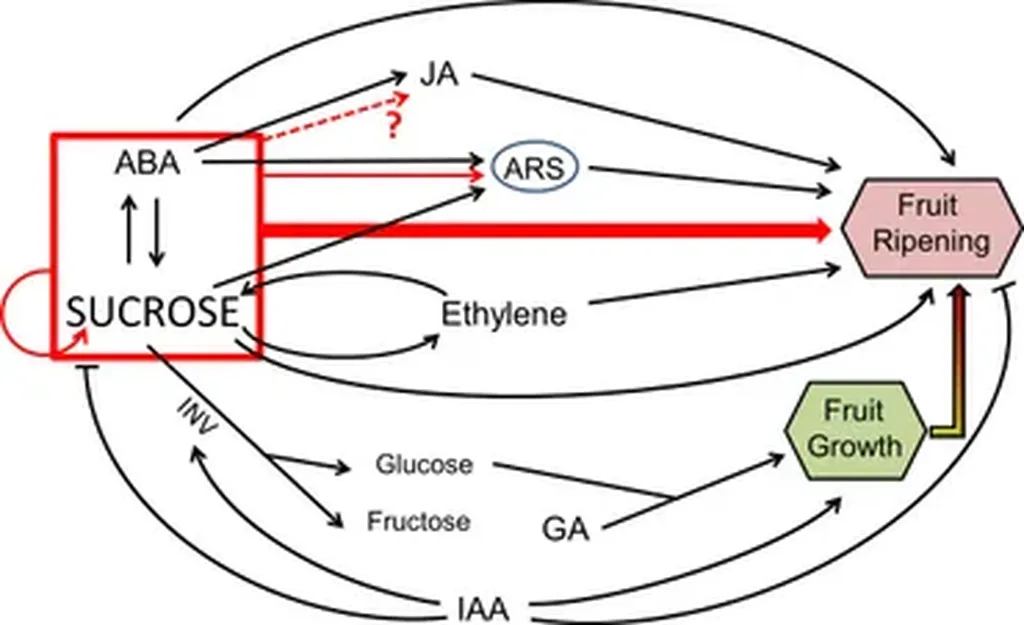
In the ever-evolving world of agriculture, understanding the intricate mechanisms that govern fruit quality is paramount. A recent review published in the journal ‘Plants’ sheds light on the regulatory processes of enzymes involved in soluble sugar metabolism in fruits, offering a roadmap for future advancements in fruit quality improvement and targeted breeding. Led by Zixin Meng of the Guangxi Engineering Research Center of Green and Efficient Development for Mango Industry, the research delves into the complex interplay of transcriptional regulation, epigenetic modifications, and signal transduction that dictate sugar accumulation in fruits.
Soluble sugars are the backbone of fruit quality, influencing sweetness, flavor, nutritional value, and texture. The content and composition of these sugars are meticulously regulated by sugar-metabolizing enzymes, including invertase (INV), sucrose phosphate synthase (SPS), sucrose synthase (SUS), fructokinase (FRK), and hexokinase (HXK). However, until now, a comprehensive analysis of their regulatory mechanisms has been lacking.
The review employs bibliometric analysis to examine research trends in fruit sugar metabolism, synthesizing recent advances in the coordinated regulatory mechanisms. “This review aims to provide a clearer framework for future research by integrating recent findings on transcriptional regulation, epigenetics, and signaling pathways,” Meng explains. At the transcriptional level, transcription factor families such as MYB, WRKY, NAC, and MADS-box achieve precise regulation of sugar metabolism-related genes by specifically binding to the promoters of their target genes.
Epigenetic regulation, including histone modifications, non-coding RNAs, and DNA methylation, influences the expression of sugar-metabolizing enzymes at the post-transcriptional level by modulating chromatin accessibility or mRNA stability. Signaling pathways integrate hormonal signals (e.g., ABA, ethylene), environmental signals (e.g., temperature, light), and sugar-derived signals into the regulatory network, forming complex feedback mechanisms.
These regulatory mechanisms not only directly affect sugar accumulation in fruits but also participate in fruit quality formation by modulating processes such as cell turgor pressure and carbon allocation. The insights gleaned from this research have significant commercial implications for the agriculture sector. By understanding and manipulating these regulatory mechanisms, farmers and breeders can enhance fruit quality, leading to improved marketability and consumer satisfaction.
The review provides a theoretical foundation for fruit quality improvement and targeted breeding, paving the way for innovative agricultural practices. As the global demand for high-quality fruits continues to rise, this research offers a promising avenue for meeting these needs. The work of Zixin Meng and colleagues, published in ‘Plants’ and affiliated with the Guangxi Engineering Research Center of Green and Efficient Development for Mango Industry, represents a significant step forward in the quest to optimize fruit quality through a deeper understanding of sugar metabolism.