
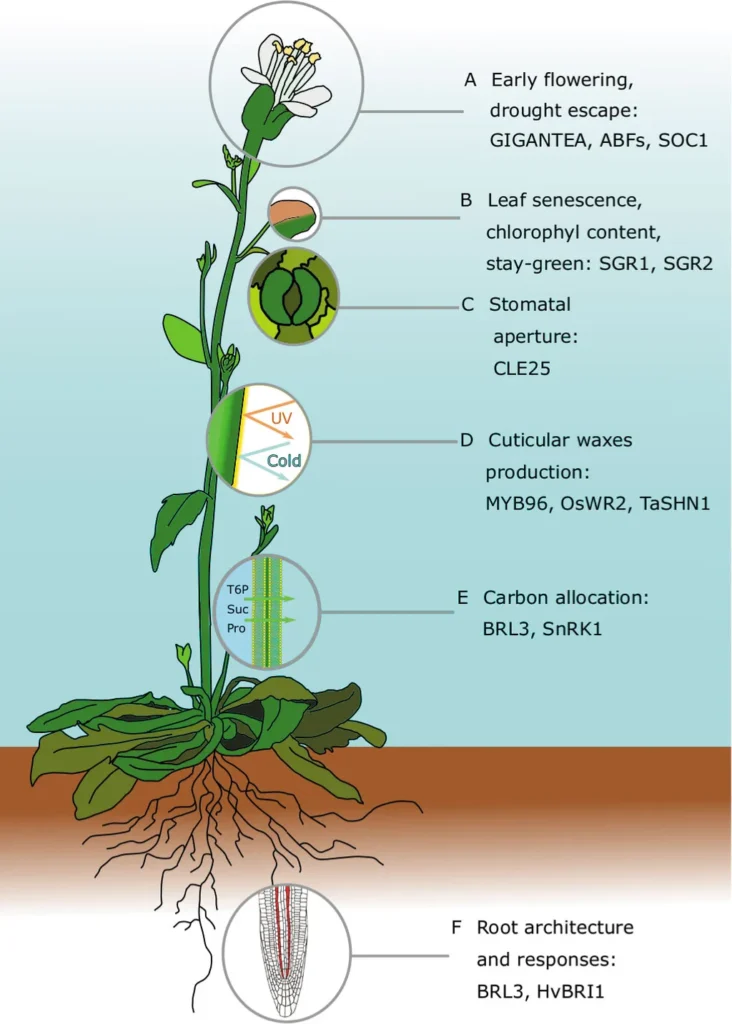
In the face of escalating climate challenges, scientists are unraveling the intricate mechanisms that enable plants to combat drought stress. A recent study published in *Nature Communications* has shed light on a rapid, peptide-mediated signaling pathway that triggers stomatal closure, offering promising avenues for developing drought-resistant crops.
The research, led by Akie Shimotohno from the Institute of Transformative Bio-Molecules (WPI-ITbM) at Nagoya University, focuses on the role of the CLE5 dodecapeptide (CLE5p) in Arabidopsis thaliana. This peptide acts as a local signal, binding to the receptor complex BARELY ANY MERISTEM 1 (BAM1)–GUARD CELL HYDROGEN PEROXIDE-RESISTANT 1 (GHR1) in guard cells, which in turn phosphorylates key regulators of drought responses. This process induces stomatal closure, minimizing water loss without the need for abscisic acid (ABA) accumulation or reactive oxygen species (ROS) buildup.
“This peptide signaling pathway represents a swift and efficient mechanism for plants to respond to drought stress,” Shimotohno explained. “By understanding this process, we can potentially engineer crops that are more resilient to water scarcity, a critical need in the face of climate change.”
The study’s findings highlight the BAM1–GHR1–CLE5p module as a central player in stomatal movement and drought-responsive gene expression. This module operates independently of ABA, offering a novel target for agricultural biotechnology. The conservation of these signaling components across plant phyla suggests that peptide-mediated stomatal closure is a widespread survival strategy, opening doors for broad agricultural applications.
For the agriculture sector, this research holds significant commercial potential. Developing crops with enhanced drought tolerance could revolutionize farming practices, particularly in arid regions. By leveraging this peptide signaling pathway, agritech companies can create genetically modified crops that require less water, thereby increasing yields and reducing the environmental impact of agriculture.
Moreover, the discovery of this rapid response mechanism challenges the conventional understanding of plant stress responses. It underscores the importance of local, peptide-mediated signaling in plant physiology, paving the way for further research into similar pathways. As Shimotohno noted, “This is just the beginning. There are likely many more peptide signals waiting to be discovered that play crucial roles in plant stress responses.”
The implications of this research extend beyond immediate agricultural applications. By deepening our understanding of plant stress responses, scientists can develop more effective strategies for crop protection and sustainability. The study’s findings could also inform the development of new biotechnological tools for monitoring and enhancing plant health.
In summary, the discovery of the CLE5p signaling pathway represents a significant advancement in our understanding of plant drought responses. By harnessing this knowledge, the agriculture sector can develop innovative solutions to some of the most pressing challenges posed by climate change. As research in this area continues to evolve, the potential for transforming agricultural practices and ensuring food security becomes increasingly promising.