
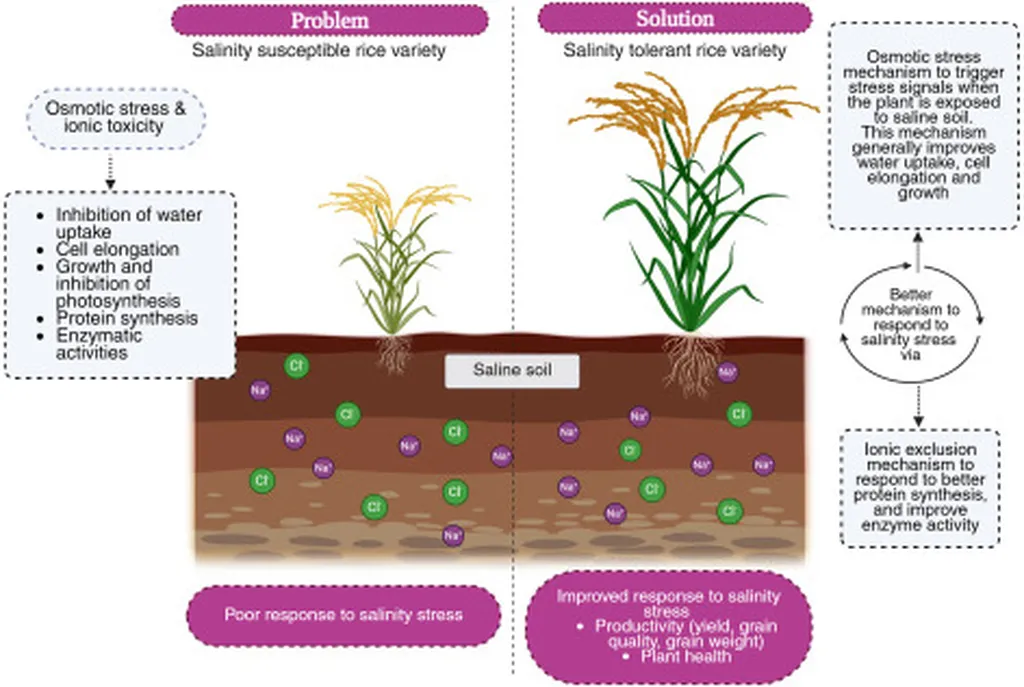
In the relentless pursuit of enhancing crop resilience, a team of researchers has made significant strides in unraveling the genetic mechanisms that enable rice to withstand salt stress. Published in *Discover Plants*, the study, led by Md. Atik Mas-ud from the College of Plant Science and Technology at Huazhong Agricultural University, identifies and characterizes key hub genes that play pivotal roles in rice’s response to salty conditions.
Salt stress is a major constraint to rice production, particularly in coastal and arid regions where soil salinity can devastate yields. The study’s lead author, Mas-ud, explains, “Understanding the genetic basis of salt tolerance is crucial for developing rice varieties that can thrive in challenging environments.” By pinpointing 10 hub genes that are central to the rice plant’s stress response network, the research provides a roadmap for future breeding programs aimed at enhancing salt tolerance.
The researchers employed a comprehensive approach, combining data mining, bioinformatics, and phylogenetic analysis to identify and characterize these hub genes. Among the genes identified are those involved in critical functions such as protein phosphorylation, ion transport, and signal transduction. “These genes are not just passive responders; they actively regulate the plant’s ability to cope with salt stress,” Mas-ud notes.
The commercial implications of this research are substantial. Rice is a staple food for over half the world’s population, and improving its resilience to salt stress could have profound impacts on global food security. By leveraging these findings, agricultural biotechnologists can develop rice varieties that are more resilient to saline conditions, thereby increasing yields and reducing the risk of crop failure in vulnerable regions.
Moreover, the study’s insights into gene ontology and expression patterns offer a deeper understanding of the molecular mechanisms underlying salt tolerance. This knowledge can be applied not only to rice but also to other crops, potentially revolutionizing the way we approach crop improvement in the face of climate change and environmental stressors.
As the agriculture sector grapples with the challenges of a changing climate, research like this provides a beacon of hope. By decoding the genetic blueprint of salt tolerance, scientists are paving the way for more resilient and productive crops, ensuring food security for future generations. The study’s findings, published in *Discover Plants* and led by Mas-ud, represent a significant step forward in the quest to build a more sustainable and resilient agricultural future.