
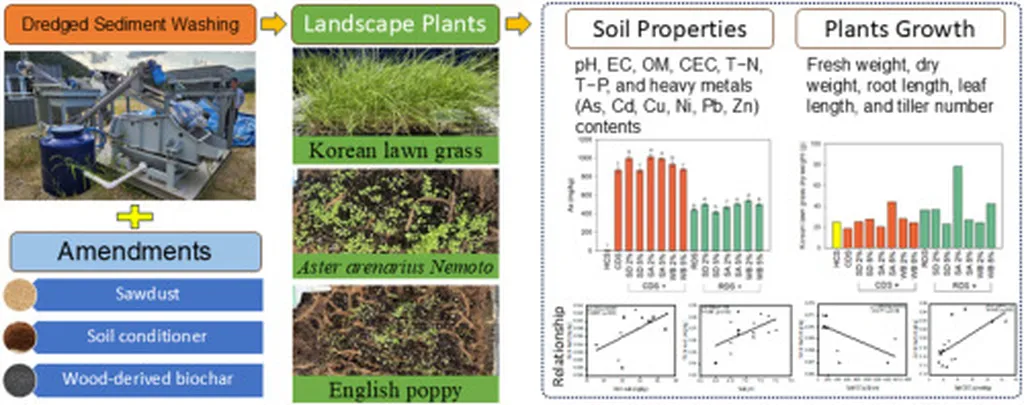
In a groundbreaking study published in the *International Journal of Sediment Research*, researchers have uncovered a promising avenue for repurposing dredged sediments, transforming them into a viable growth medium for landscape plants. This research, led by Jae-In Lee from the Institute of Agricultural Environmental Science at Hankyong National University, could revolutionize how we manage sediment waste while offering sustainable solutions for the agriculture and horticulture sectors.
Dredged sediments, often considered a nuisance due to their potential contamination, have been underutilized despite their abundance. However, this study demonstrates that when properly remediated and amended, these sediments can support the growth of ornamental plants, including Korean lawn grass (KLG), Aster arenarius Nemoto, and English poppy. The key to this transformation lies in the remediation process and the strategic use of soil amendments.
The research team compared contaminated dredged sediment (CDS) with remediated dredged sediment (RDS) and commercial horticultural soil as a control. They found that RDS provided a more suitable substrate for plant development. Notably, KLG showed significant growth improvements, particularly when supplemented with wood-derived biochar and soil conditioner (SC). “The incorporation of soil conditioner into contaminated dredged sediment markedly improved the biomass of Korean lawn grass,” Lee explained. “At 2% and 5% SC, we observed dry weight increases of 7.4% and 136.9%, respectively.”
The study also delved into the impact of soil properties on heavy metal(loid) accumulation in plants. Significant correlations were found between soil and leaf Ni concentrations, and soil pH, electrical conductivity, and cation exchange capacity were identified as key factors influencing Pb and Zn levels in plant tissues. These findings highlight the importance of understanding soil chemistry in the context of sediment remediation and plant cultivation.
The commercial implications of this research are substantial. By repurposing dredged sediments, the agriculture sector could reduce waste disposal costs and create a sustainable growth medium. This approach not only supports environmental restoration initiatives but also offers a cost-effective solution for landscape plant production. As Lee noted, “Adequately remediated and amended RDS has the potential to be utilized as a sustainable medium for landscape plant production.”
This research opens the door to future developments in the field of agritech and environmental science. As we strive for more sustainable practices, the repurposing of dredged sediments could become a cornerstone of innovative agricultural techniques. The study’s findings, published in the *International Journal of Sediment Research*, underscore the importance of interdisciplinary research in addressing both environmental and agricultural challenges.