
In a groundbreaking study published in the *Journal of Animal Science and Biotechnology*, researchers have uncovered a novel mechanism by which maternal undernutrition impacts fetal rumen development in sheep. The findings, led by Peng Jiao from the College of Animal Science and Technology at Anhui Agricultural University, shed light on the intricate epigenetic pathways that could have significant implications for the agriculture sector.
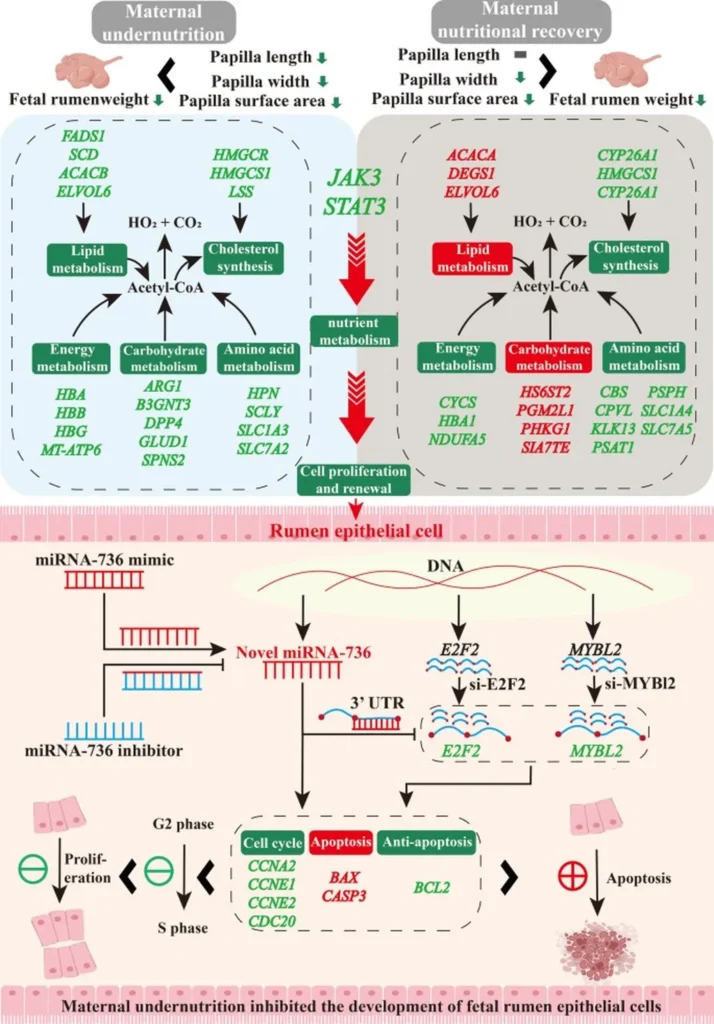
The study focused on the effects of maternal undernutrition on male fetal rumen development, utilizing both undernourished and nutrition-recovery pregnant sheep models. The results revealed that maternal undernutrition significantly reduced fetal rumen weight and papilla dimensions, impairing nutrient metabolism and energy production. This disruption was mediated through the JAK3/STAT3 signaling pathway, which inhibited cell cycle progression and subsequently hindered fetal rumen development.
One of the most intriguing findings was the identification of 64 differentially expressed miRNAs (DEMs) in the fetal rumen of undernourished ewes compared to controls. Among these, novel miR-736 was found to be overexpressed in both undernourished and nutrition-recovery models. Further investigation pinpointed E2F transcription factor 2 (E2F2) and MYB proto-oncogene like 2 (MYBL2) as key targets of miR-736. “We confirmed that novel miR-736 targeted and downregulated E2F2 and MYBL2 expression levels,” explained Jiao. “Silencing these genes promoted apoptosis and inhibited S-phase entry in rumen epithelial cells, ultimately stunting fetal rumen development.”
The commercial implications of this research are profound. Understanding the epigenetic mechanisms underlying maternal undernutrition-induced developmental deficits can pave the way for targeted interventions to improve livestock health and productivity. “This study provides new insights into the epigenetic mechanisms underlying maternal undernutrition-induced male fetal rumen developmental deficits,” Jiao noted. By identifying specific miRNAs and their target genes, researchers can develop strategies to mitigate the adverse effects of undernutrition, potentially enhancing the growth and development of livestock.
The findings also highlight the importance of maternal nutrition in agricultural practices. Ensuring optimal nutrition for pregnant ewes could lead to healthier offspring with improved rumen development, ultimately boosting the efficiency and profitability of livestock farming. As the agriculture sector continues to seek innovative solutions to enhance productivity, this research offers a promising avenue for exploration.
In the broader context, this study underscores the critical role of epigenetics in animal health and development. By unraveling the complex interplay between nutrition, gene expression, and developmental outcomes, researchers can develop more effective strategies to support animal welfare and agricultural sustainability. The insights gained from this research could shape future developments in the field, driving advancements in animal nutrition and breeding practices.
As the agriculture sector grapples with the challenges of feeding a growing global population, understanding the epigenetic impacts of maternal nutrition becomes increasingly vital. This research not only advances our scientific knowledge but also offers practical solutions to enhance livestock health and productivity, ultimately contributing to a more sustainable and efficient agricultural system.