
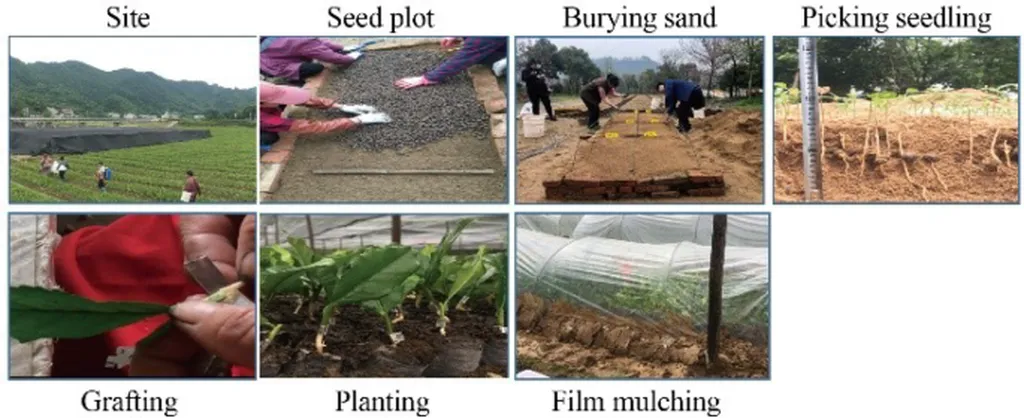
In the world of tea cultivation, a silent battle rages beneath the lush green leaves. The fungal pathogen Colletotrichum camelliae, a notorious foe, has long plagued tea plants, causing devastating losses in yield and quality. But a new study published in *Frontiers in Plant Science* offers a glimmer of hope, revealing how grafting tea plants onto resistant rootstocks can trigger a systemic defense response, potentially revolutionizing disease management in the tea industry.
The research, led by Yue-Xin Li from the Tea Research Institute at the Guizhou Academy of Agricultural Sciences, employed a multi-omics approach to unravel the molecular mechanisms behind this enhanced resistance. By integrating RNA sequencing, small RNA sequencing, and metabolomics, the team profiled the systemic defenses of susceptible tea plants grafted onto resistant rootstocks.
The results were striking. Hetero-grafting conferred near-complete resistance, reducing lesion diameters by a remarkable 98.71% compared to ungrafted controls. “This is a significant finding,” says Li. “It shows that grafting can be a powerful tool in our fight against this devastating pathogen.”
The study identified extensive reprogramming of phenylpropanoid biosynthesis, sulfur metabolism, and plant hormone signaling. Notably, specific microRNA-mRNA regulatory modules were found to play a crucial role. For instance, the downregulation of csi-miR395b-3p and a novel miR397 was paralleled by the upregulation of their targets in sulfur assimilation and lignin biosynthesis, respectively. This suggests that microRNAs are key players in reinforcing both structural and biochemical defenses.
The commercial implications of this research are substantial. Tea is a major cash crop, with global production valued at over $14 billion annually. Disease outbreaks can lead to significant economic losses, affecting farmers’ livelihoods and the tea industry as a whole. By providing a sustainable and effective control strategy, this research could help secure the future of tea cultivation.
Moreover, the elucidated modules offer actionable targets and genetic resources for breeding and grafting strategies. This could pave the way for developing new tea varieties with enhanced resistance, further bolstering the industry’s resilience against diseases.
As we look to the future, this research opens up exciting possibilities. “Understanding these molecular mechanisms is just the first step,” Li explains. “The next challenge is to translate these findings into practical applications that can benefit tea farmers worldwide.”
In the ongoing battle against Colletotrichum camelliae, this study marks a significant victory. By harnessing the power of grafting and multi-omics analysis, we are one step closer to ensuring the health and prosperity of tea plants and the industry that depends on them.